
Avacta presents pre|CISION payload data against Enhertu and Datroway

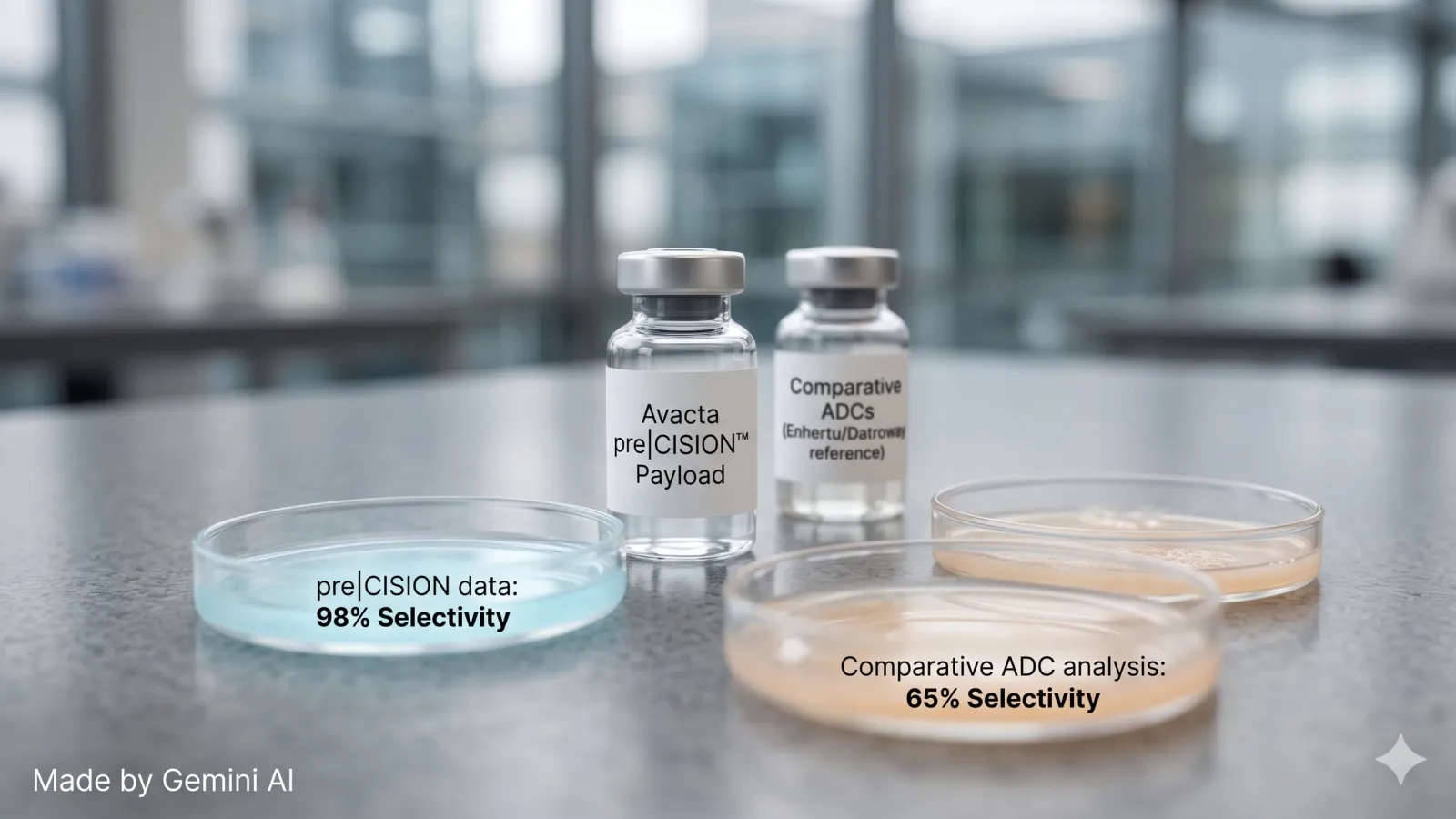
Avacta Therapeutics has presented new preclinical data at its Science Day 2026 event in London, offering head-to-head comparisons of its pre|CISION® peptide drug conjugate (PDC) platform against two approved antibody-drug conjugates (ADCs) and updated dual-payload results from a second programme.
The AIM-listed company shared findings across two programmes: AVA6103, which compares FAP-cleavable exatecan delivery against Enhertu® (trastuzumab deruxtecan, Daiichi Sankyo/AstraZeneca) and Datroway® (datopotamab deruxtecan, Daiichi Sankyo); and AVA6207, a dual-payload candidate that showed durable complete responses in models where Enhertu® failed to prevent tumour regrowth.
AVA6103: Delivery kinetics and tumour selectivity
All three drugs — AVA6103, Enhertu®, and Datroway® — deliver topoisomerase I inhibitors (exatecan or deruxtecan) to tumours, allowing Avacta to design comparisons that control for cancer-model variables. The pharmacokinetic data showed that exatecan released from AVA6103 reached peak tumour concentration within minutes, compared with more than 24 hours for deruxtecan derived from either approved ADC. The maximal concentration (Cmax) of released payload in the tumour differed by more than one order of magnitude in favour of AVA6103.
Avacta also reported that the tumour selectivity index (TSI) — which measures the ratio of drug exposure in the tumour versus the bloodstream — was at least three times higher for AVA6103's released exatecan than for deruxtecan from either comparator. The company said it intends to publish these findings at an upcoming academic conference and in a peer-reviewed journal.
AVA6207: Dual payload and FAP-low models
Updated in vivo data from the AVA6207 programme, an extension of initial results presented at AACR 2026 last month, showed that dual payload delivery produced prolonged deep complete responses in a FAP-high model (HEK-FAP) even when conventional cytotoxic drugs failed to prevent tumour regrowth. In a FAP-low, HER2-positive patient-derived xenograft model of gastric cancer, AVA6207 produced durable responses in settings where Enhertu® was associated with tumour regrowth — a finding the company described as the first demonstration of an efficacy advantage over single-payload ADCs in this model type.
Chief executive Christina Coughlin said the data "further underline the potential of our unique pre|CISION® technology to improve treatment options for cancer patients" and added that the company is "building momentum and enhancing our IP at a pace that we are confident exceeds industry norms."
Market context and competitive read-across
The ADC sector has attracted significant investment and M&A interest over the past two years, driven in large part by the commercial success of Enhertu® across multiple tumour types. Several companies — including established players and university spinouts — are now exploring next-generation conjugate formats, including PDCs, bicyclic peptide conjugates, and bispecific ADCs, in an effort to address the systemic toxicity that remains a key liability of conventional ADC design.
Avacta's FAP-targeted approach sidesteps the antibody altogether, relying instead on a tumour-specific protease cleavage mechanism to release payload locally. The FAP-low gastric cancer results are notable because FAP expression varies considerably across tumour types and patient populations; demonstrating activity in a low-FAP model would broaden the potential addressable population and reduce a significant clinical risk for the platform. The company's lead clinical programme, faridoxorubicin (AVA6000), has already shown preliminary activity in salivary gland cancer and soft tissue sarcoma, providing some clinical anchoring for the preclinical narrative being built around later-generation programmes.
Investors will be watching for peer-reviewed publication of the AVA6103 comparator data and for any update on clinical timelines for AVA6207, as the programme moves beyond in vivo proof-of-concept.