
Tempest Therapeutics to present TPST-2003 CAR-T data at ISCT 2026

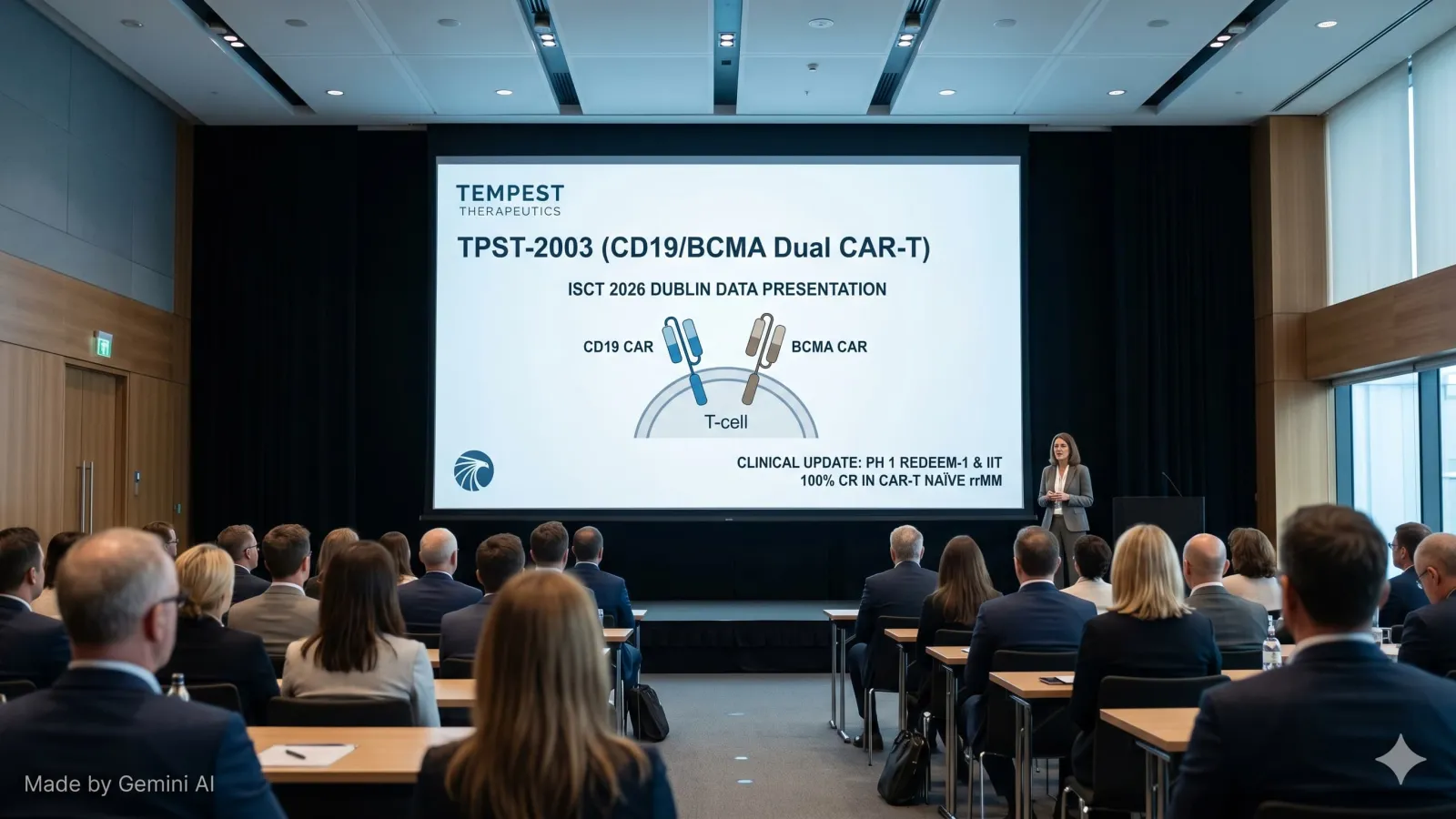
Tempest Therapeutics will present updated clinical data from its lead cell therapy candidate, TPST-2003, at the International Society for Cell & Gene Therapy Annual Meeting in Dublin on 6–9 May 2026. The Brisbane, California-based company will deliver an oral presentation on 6 May covering data from the ongoing REDEEM-1 Phase 1/2a trial, alongside a poster session the following evening.
TPST-2003 is an autologous CAR-T construct engineered to target both BCMA and CD19 simultaneously via a parallel dual-targeting architecture. The design is intended to counter tumour heterogeneity and antigen escape — two mechanisms by which multiple myeloma cells can evade single-target therapies — and Tempest has specifically enrolled patients with extramedullary disease, a high-risk presentation associated with particularly poor outcomes under conventional regimens.
REDEEM-1 interim results
Earlier in 2026, Tempest disclosed interim data from REDEEM-1 showing a 100% complete response rate across all six efficacy-evaluable patients, assessed under International Myeloma Working Group uniform response criteria, alongside what the company described as a favourable safety profile. The trial, sponsored and conducted in China by Tempest's partner Novatim Immune Therapeutics, targets a full enrolment of 29 patients across eight Chinese clinical sites, including Peking Union Medical College Hospital as the lead site.
Matt Angel, president and chief executive of Tempest, said the company believes that "replicating these results in the remainder of the REDEEM-1 trial and in a registrational trial would position TPST-2003 as a class-leading therapy" for relapsed/refractory multiple myeloma. The ISCT presentation will include additional data from two further Novatim-sponsored studies: a Phase 1/2 investigator-initiated trial in relapsed/refractory myeloma and a Phase 1 study evaluating TPST-2003 in POEMS, a rare plasma-cell disorder.
Under its licensing agreement with Novatim, Tempest holds exclusive development rights for TPST-2003 outside China, India, Turkey, and Russia — a geographic carve-out that reflects common structuring in China-origin cell therapy partnerships.
Competitive and regulatory context
The CD19/BCMA dual-targeting approach positions TPST-2003 in an increasingly crowded but scientifically validated corner of the cell therapy market. Approved BCMA-targeting CAR-T products — including ciltacabtagene autoleucel and idecabtagene vicleucel — have demonstrated high response rates in late-line myeloma, yet relapse remains common, in part because of antigen loss. Dual-targeting constructs, which add CD19 to the BCMA axis, are a widely pursued strategy among academic groups and emerging biotechs to address this vulnerability, though none has yet achieved regulatory approval in the indication.
A 100% complete response rate in six patients is encouraging but carries the statistical caveat inherent in any very small interim cohort; investors and clinicians will be looking for maintained responses as REDEEM-1 reaches its 29-patient target. The path to a registrational trial in the United States or Europe would require alignment with the FDA or EMA on a trial design — discussions Tempest has not yet announced. MHRA's recently updated guidance on advanced therapy medicinal products also presents a relevant framework for any European filing.
Given Tempest's early-stage profile and its reliance on a China-based partner for all current clinical operations, the forthcoming ISCT dataset will be a material read-out for the company's development trajectory and its ability to attract the additional capital it has flagged as necessary in its most recent annual report.