
OSE Immunotherapeutics posts €37.7m net loss as runway nears Q4 2026

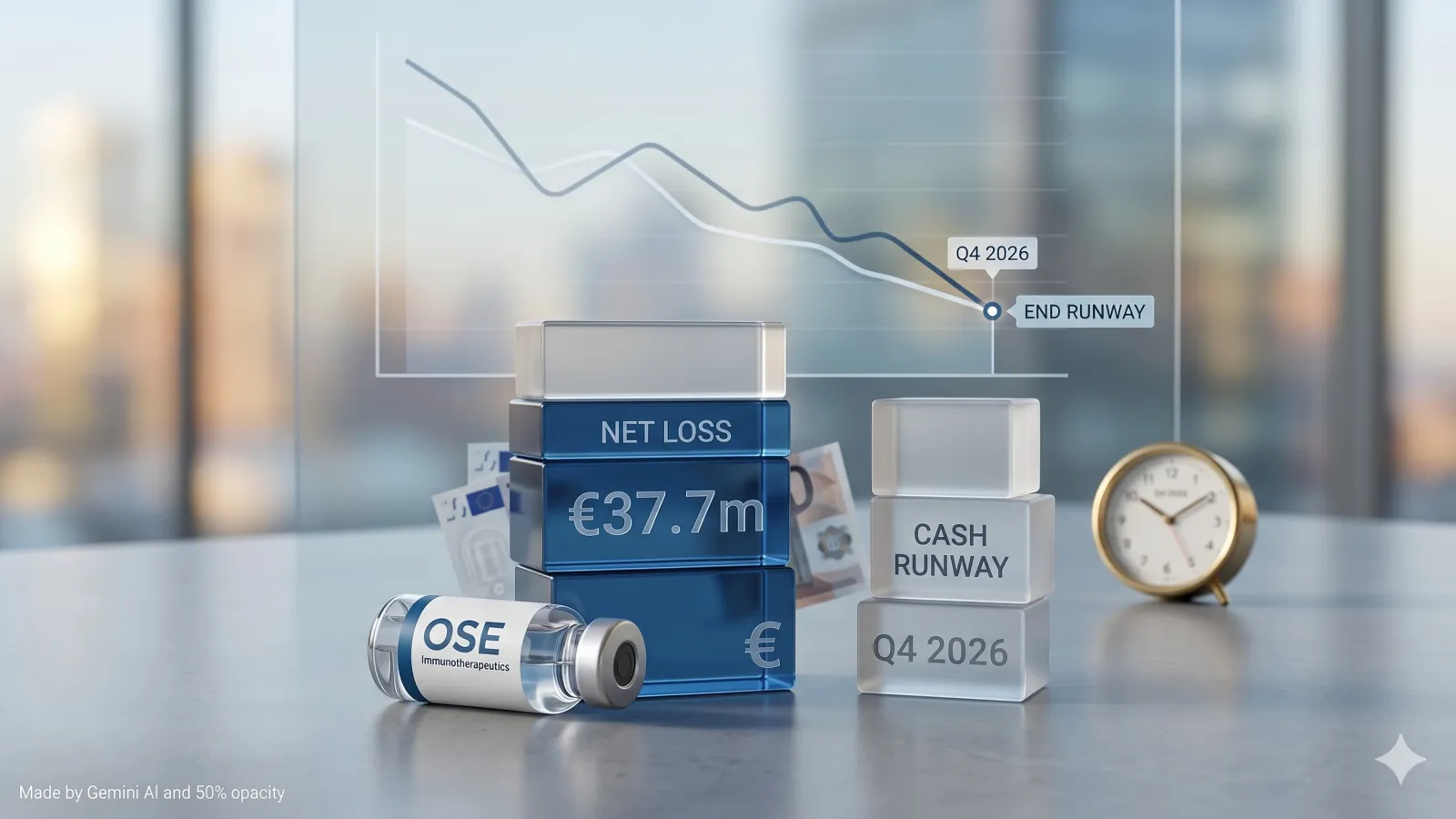
OSE Immunotherapeutics has reported a net loss of €37.7 million for full year 2025, swinging from a profit of €37.4 million a year earlier, as the one-off licensing income that inflated its 2024 results fell away and operating cash burn accelerated to fund its clinical programmes.
Revenues collapsed to €2.6 million in 2025 from €69.9 million in 2024, a difference explained almost entirely by timing: the prior year benefited from the immediate recognition of the majority of a $48 million upfront payment from AbbVie's licensing of OSE-230, alongside €25.3 million from an amendment to its agreement with Boehringer Ingelheim on BI 765063 and €13.5 million from the sale of its "cis-targeting" anti-PD1/cytokine platform. In 2025, those exceptional items were absent.
Cash position and going concern risk
The company's total cash position stood at €22.7 million at 31 December 2025, declining further to €17.0 million by 31 March 2026. OSE estimates its current resources will fund operations only until the beginning of the fourth quarter of 2026, a runway it described as unchanged from prior guidance.
Critically, the statutory auditors have not yet completed their review of the 2025 consolidated financial statements. OSE has postponed publication of its audited accounts and Universal Registration Document — the French equivalent of an annual report filed with the Autorité des Marchés Financiers — to no later than 28 May 2026. The company acknowledged that should no sufficient financing transaction be completed in time, auditors are expected to include a going concern qualification in their certification report.
To extend its runway, management is exploring several routes: a new strategic partnership for one of its proprietary assets, equity financing, restructuring of existing debt, and potential milestone receipts from current partnerships. The warrant facility with Vester Finance, previously one avenue for equity top-up, was fully terminated in April 2026 and is excluded from runway calculations.
Programme context and governance backdrop
Research and development expenses rose 11.5% year-on-year to €33.9 million, driven principally by recruitment into Artemia, the Phase 3 pivotal trial of cancer vaccine Tedopi in non-small cell lung cancer, along with a lower Research Tax Credit receipt. General and administrative expenses jumped 34.0% to €8.8 million, a figure OSE attributed substantially to legal costs arising from a contentious Annual General Meeting held in September 2025 that resulted in a complete renewal of the company's board and governance structure, as well as legal proceedings against certain minority shareholders.
OSE's pipeline is concentrated on two assets: lusvertikimab, an anti-IL-7Rα antibody partnered with Boehringer Ingelheim in immuno-inflammation, and Tedopi, its neoepitope-based cancer vaccine. Both programmes have experienced governance turbulence, and the company's ability to reach near-term milestones will depend heavily on its capacity to close a financing transaction within the next two to three quarters.
The broader context for European clinical-stage immunology and immuno-oncology biotechs remains difficult. Macro uncertainty, higher interest rates, and a selective capital market have made mid-round fundraising challenging for companies without near-term data catalysts. OSE's situation — a constrained runway, an unresolved audit, and a governance reset completed less than a year ago — adds layers of execution risk that investors will weigh carefully against the potential value of the Artemia readout and any lusvertikimab partnering progress.