
Tonix Pharmaceuticals presents Phase 1 data for Lyme mAb TNX-4800

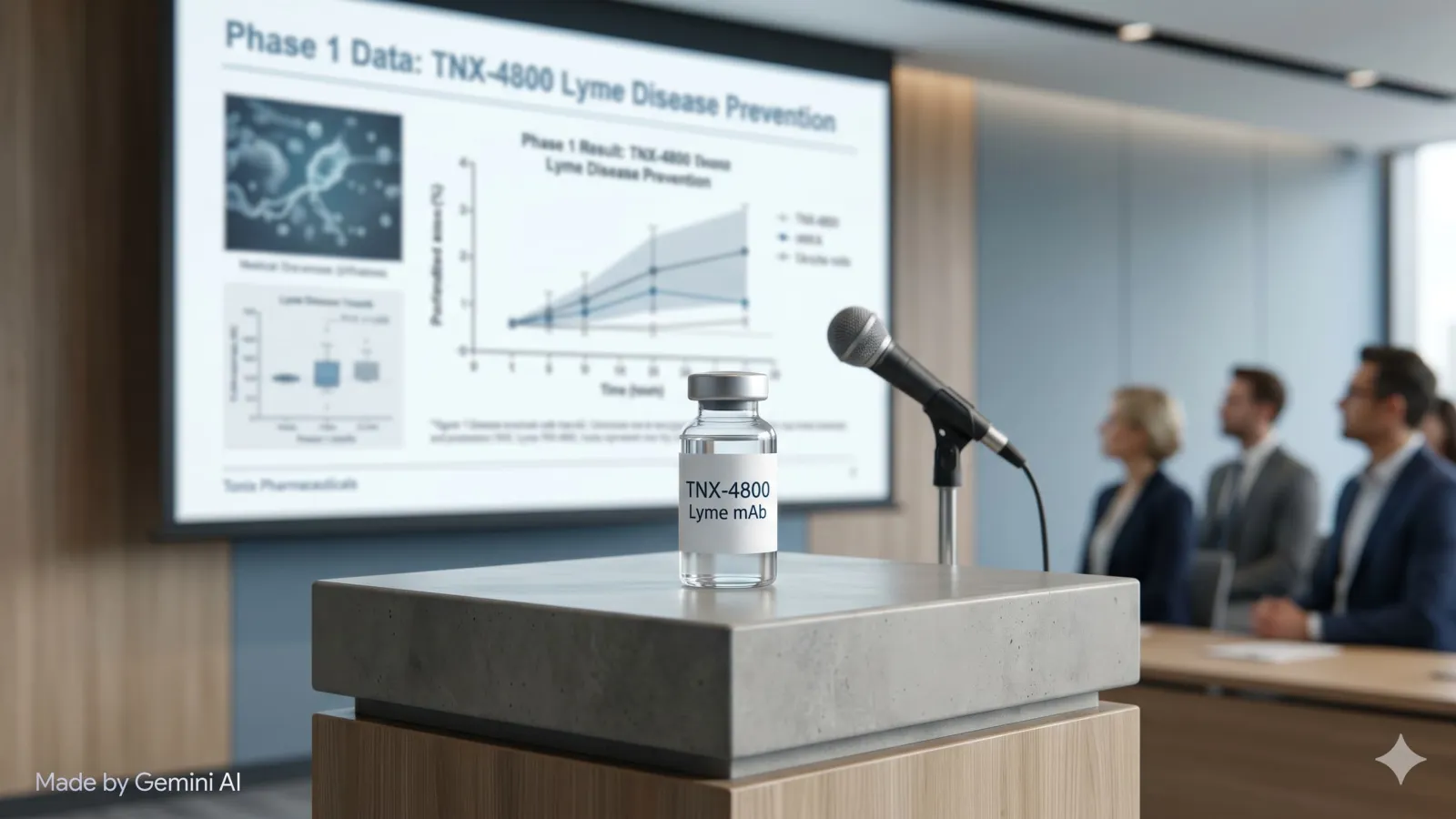
Tonix Pharmaceuticals has shared Phase 1 results for TNX-4800, its long-acting human monoclonal antibody targeting Borrelia burgdorferi, and outlined a path toward a Phase 2 field study targeting the prevention of Lyme disease. The data were presented at the 4th Annual Ticks and Tickborne Diseases Symposium at Johns Hopkins University on 29 April 2026.
TNX-4800, in-licensed from UMass Chan Medical School in 2025, works by targeting outer surface protein A (OspA) on Borrelia bacteria. Its Fc domain has been engineered to extend serum half-life, and it is designed to confer passive immunity within two days of subcutaneous administration — without requiring the recipient's immune system to generate antibodies. The company reports that serum concentrations remained measurable in the majority of participants for up to 12 months after a single dose.
Phase 1 results
The Phase 1 dose-escalation study (NCT04863287), led by Mark Klempner at UMass Chan, enrolled 44 healthy adults who received a single subcutaneous dose of placebo or TNX-4800 at 0.5, 1.5, 5, or 10 mg/kg. The study found no significant clinical or laboratory safety signals; all drug-related adverse events were mild or moderate, with one severe event deemed unrelated to the drug. Anti-drug antibodies appeared transiently in fewer than 10% of treated participants with no pharmacokinetic impact. The highest dose evaluated in rats was designated the No Observed Adverse Effect Level.
Chief executive Seth Lederman said the pharmacokinetic profile from Phase 1 supports a two-dose regimen for the planned Phase 2 study — an initial spring dose followed by a booster two months later, with the primary endpoint being prevention of confirmed Lyme disease over six months.
Tonix has scheduled a Type C meeting with the FDA in the third quarter of 2026 to discuss the adaptive Phase 2 field study design. Pending FDA agreement, the study is expected to start in the first half of 2027 and will enrol adults and adolescents aged 16 and older living or working in Lyme-endemic regions of the United States.
Competitive landscape
There are currently no FDA-approved vaccines or prophylactics for Lyme disease in the United States. Pfizer and Valneva are advancing VLA15 (now known as Lyme VAX), an alum-adjuvanted, multi-OspA subunit vaccine, in a late-stage field efficacy programme — the asset that Tonix refers to when contrasting TNX-4800 against "the alum-based combination multi-OspA subunit vaccine in late-stage clinical development." A previous OspA subunit vaccine, LYMErix, was withdrawn from the market in 2002, a history the company cited explicitly in its release as context for the adherence challenges associated with multi-dose schedules.
The monoclonal antibody route is clinically distinct from vaccination: it bypasses immune priming entirely and could in principle be administered seasonally in endemic areas, similar to respiratory syncytial virus prophylaxis models in paediatric settings. Tonix positions this rapid-onset profile as a differentiated alternative for individuals who need protection at short notice, or who are poor candidates for vaccine-based immunity schedules.
With roughly 87 million Americans living, working, or recreating in tick-endemic zones, and Lyme disease incidence reportedly climbing year on year as tick habitat expands, the public health argument for an accessible prophylactic is credible. Whether a seasonal subcutaneous regimen achieves the uptake that a vaccine did not will depend heavily on prescriber behaviour, payer coverage decisions, and how Phase 2 efficacy data read out against the comparator arm — questions that will not be answered before late 2027 at the earliest.