
Tiziana sees neuroinflammation fall in third MSA patient on foralumab

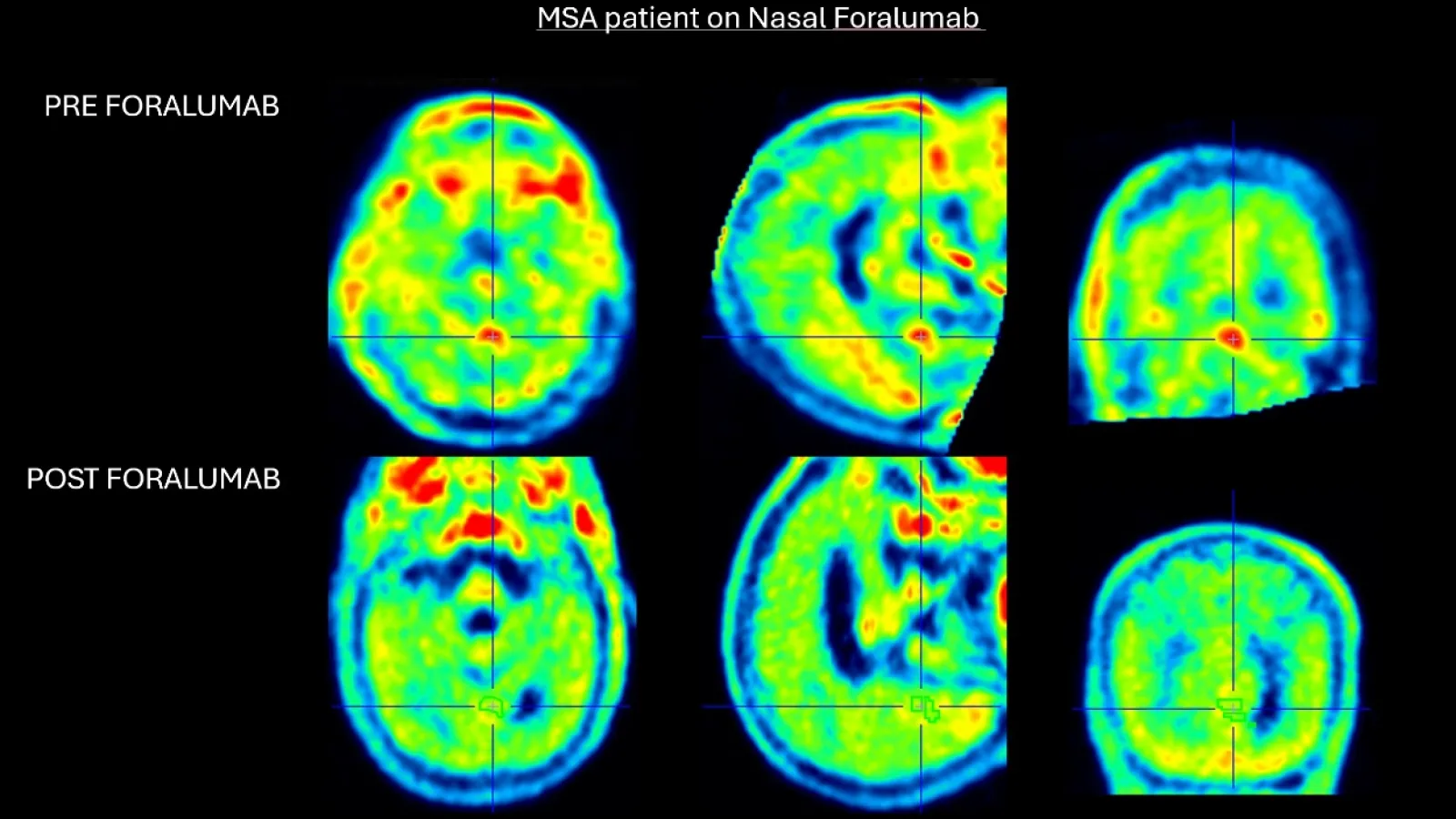
Tiziana Life Sciences has reported quantitative PET imaging results from a third patient with Multiple System Atrophy (MSA) enrolled in its Phase 2 trial of intranasal foralumab, a fully human anti-CD3 monoclonal antibody. The data, released on 31 July 2026, show reductions in neuroinflammatory activity broadly in line with those previously seen in the first two treated patients.
PET scans conducted before and after treatment showed a reduction of up to 34% in standardised uptake value (SUV) and 26% in standardised uptake value ratio (SUVR) in brain regions most affected in MSA, specifically the basal ganglia and cerebellar white matter. The first two patients showed reductions of approximately 35% in SUV and 24% in SUVR, making the third patient's results closely consistent with that earlier signal.
The imaging findings
Tarun Singhal, founding director of the NeuroPET Programme at Brigham and Women's Hospital and associate professor of neurology at Harvard Medical School, said the consistency across patients was encouraging, while noting that correlation with clinical features and further confirmation using additional quantitative techniques should be performed. The measured reductions in radiotracer uptake are interpreted by Tiziana as evidence that foralumab is dampening neuroinflammation through mucosal tolerance mechanisms, an approach intended to avoid the systemic toxicities associated with intravenous anti-CD3 therapy.
Ivor Elrifi, chief executive of Tiziana, said the reproducible PET reductions in a third patient strengthened the company's confidence in foralumab's potential, pointing also to signals observed in non-active secondary progressive multiple sclerosis and moderate Alzheimer's disease studies.
MSA is a rare progressive neurodegenerative disorder characterised by autonomic dysfunction, parkinsonism and cerebellar ataxia. There are no approved disease-modifying treatments, and median survival after diagnosis is typically in the range of six to ten years, making the unmet medical need acute.
Market and competitive context
The MSA therapeutic landscape remains sparse precisely because the condition is rare, poorly understood at a mechanistic level, and has historically resisted drug development. Several investigational programmes targeting neuroinflammation or protein aggregation are in early clinical stages, but no candidate has yet demonstrated a convincing disease-modifying effect in a randomised, controlled trial. Tiziana's foralumab is positioned as the only fully human anti-CD3 monoclonal antibody currently in clinical development, a distinction that may offer some differentiation in mechanism relative to earlier, less human-tolerant anti-CD3 constructs.
The broader neuroinflammation space has attracted renewed interest as PET imaging biomarkers become more established tools for tracking microglial activation in vivo. If foralumab's PET signal translates into a measurable clinical benefit, it could support a regulatory pathway through accelerated or conditional approval routes, both of which the FDA and EMA have applied in rare neurodegenerative indications when imaging endpoints correlate with functional outcomes. That correlation has yet to be demonstrated for foralumab in MSA, and Singhal's caveat about clinical feature correlation is a material qualification that investors should note.
Tiziana also has an expanded access programme for non-active secondary progressive multiple sclerosis, with 14 patients dosed to date showing improvement or stability at six months, and a separate Phase 2a randomised, placebo-controlled trial in the same indication under way. The multi-indication strategy spreads risk but also demands careful resource prioritisation for a NASDAQ-listed clinical-stage company.
The company said it plans to continue dosing additional MSA patients to further characterise foralumab's potential. No timeline for a full dataset readout or regulatory engagement on the MSA programme was disclosed in the announcement.