
Pharvaris HAE prophylaxis trial hits 83% attack rate reduction

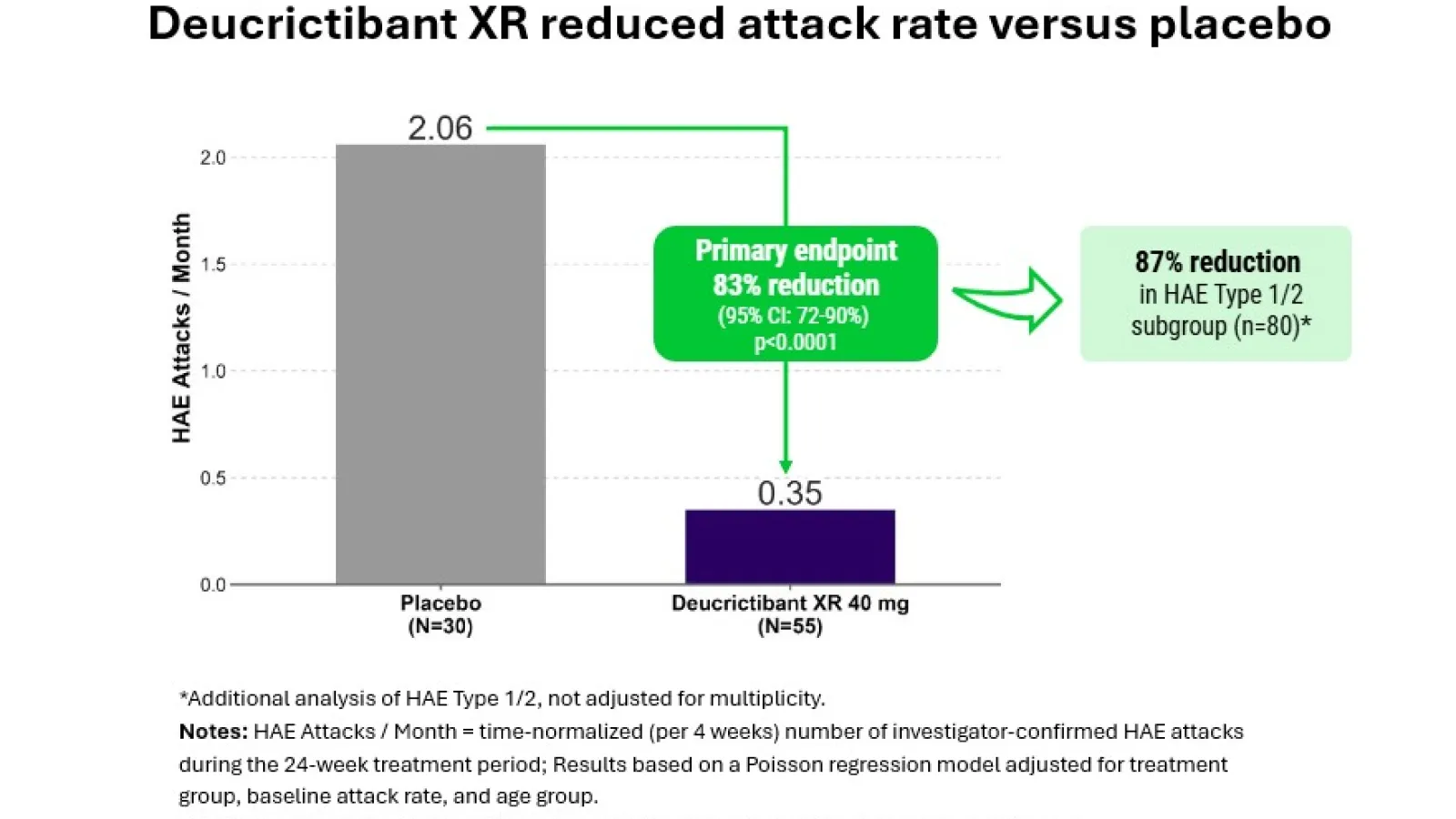
Pharvaris has reported positive topline data from CHAPTER-3, its pivotal Phase 3 study of deucrictibant extended-release (XR) tablet for the prophylactic treatment of hereditary angioedema (HAE). The once-daily oral therapy reduced mean monthly attack rates by 83% versus placebo across all three HAE subtypes, with statistical significance reaching p<0.0001. All secondary efficacy endpoints were also met under a pre-specified multiplicity-control procedure.
The NASDAQ-listed Swiss biotech randomised 85 participants from 21 countries in a 2:1 ratio to deucrictibant XR or placebo across 24 weeks. In the 80-participant subset with HAE Type 1 or Type 2, the attack rate reduction reached 87% versus placebo. The company reported early-onset protection within the first week of dosing, sustained through the full study period. No treatment-related serious adverse events were observed, and the discontinuation rate was one participant per arm.
Regulatory path
Pharvaris plans to submit marketing authorisation applications based on the CHAPTER-3 dataset from the first half of 2027. An NDA for deucrictibant immediate-release (IR) capsules, targeting on-demand treatment of acute HAE attacks, is already under active FDA review following the RAPIDe-3 data package. Deucrictibant holds orphan drug designation from the FDA, the European Commission, and Swissmedic, which confers certain incentives on the regulatory path to approval in each jurisdiction.
A long-term open-label extension, CHAPTER-4, is ongoing. Pharvaris is also running CREAATE, a pivotal Phase 3 study of deucrictibant XR in acquired angioedema due to C1 inhibitor deficiency, with Part 1 topline data anticipated in the first quarter of 2027.
Marc Riedl, Professor of Medicine and Clinical Director of the US Hereditary Angioedema Association Angioedema Center at the University of California San Diego, and a principal investigator in CHAPTER-3, said the data "further confirm the value of targeting the bradykinin B2 receptor for both the prevention and treatment of attacks across all types of HAE," and noted that oral administration and tolerability could support individualised treatment strategies in clinical practice.
Market context
HAE prophylaxis is a relatively concentrated but commercially significant rare-disease market. The current standard of care includes subcutaneous and intravenous therapies such as plasma-derived and recombinant C1 inhibitor products and the subcutaneous kallikrein inhibitor lanadelumab. No oral prophylactic has yet been approved, and Pharvaris positions deucrictibant XR as potentially the first to combine oral convenience with efficacy broadly comparable to injectable agents. If approved, this profile could disrupt adherence patterns among the estimated one in 50,000 people affected globally.
Berotralstat, an oral plasma kallikrein inhibitor from BioCryst Pharmaceuticals, is the only other approved oral agent in the HAE space, though it targets a different mechanism and is indicated for prophylaxis in Type 1 and Type 2 HAE only. Deucrictibant's B2 receptor antagonism and its coverage across all three HAE types, including the less common normal-C1 inhibitor subtype, are presented by Pharvaris as differentiating features, though cross-trial efficacy comparisons are inherently limited.
The company stated it is preparing simultaneously for two potential product launches, covering both on-demand and prophylactic settings, which represents a meaningful operational and commercial build-out for a company of this stage. Investors will focus on the NDA review timeline for the IR formulation and the completeness of the XR filing package when submissions open next year.