
Absci reports clean Phase 1 safety data for anti-PRLR antibody ABS-201

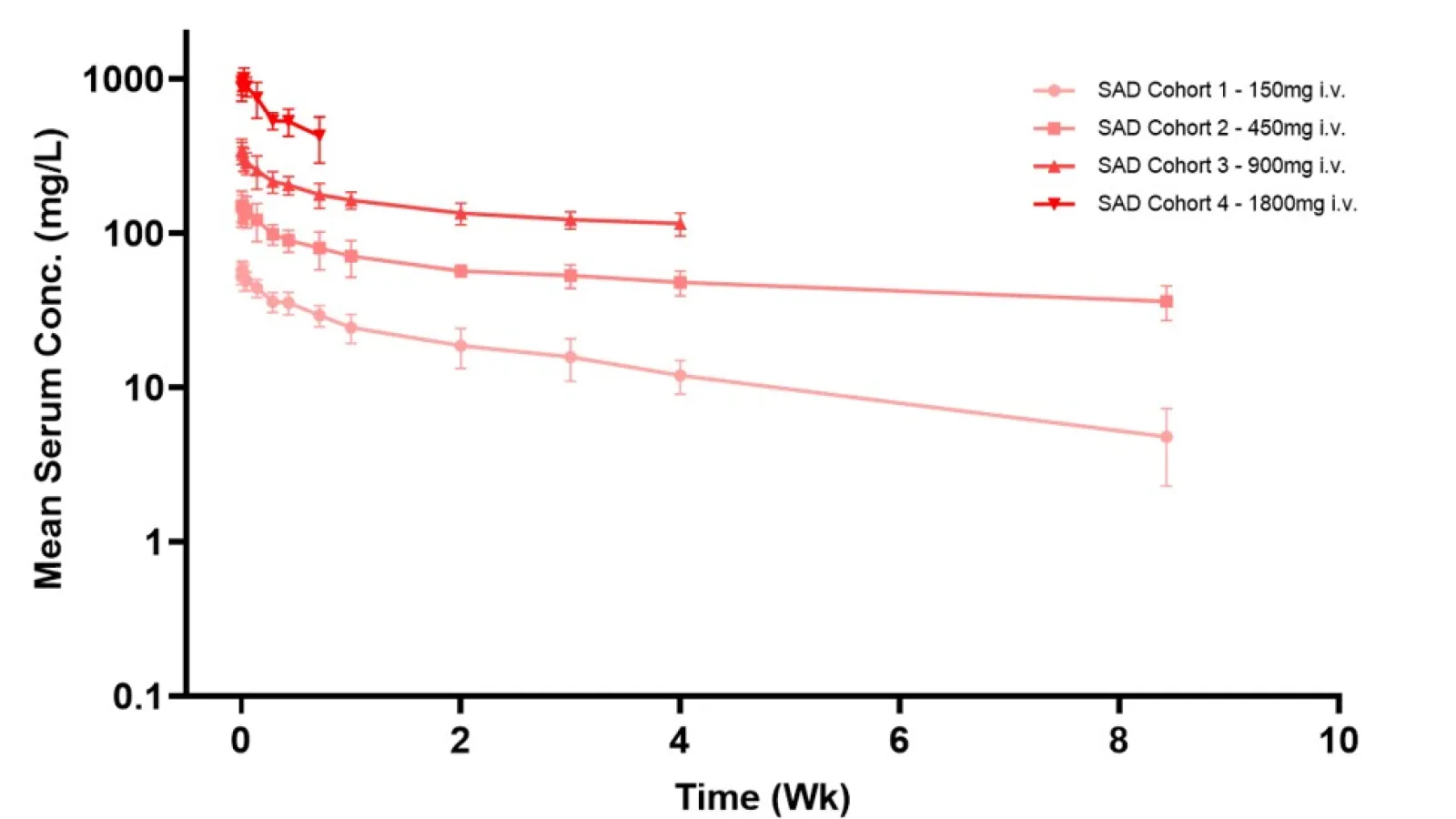
Absci Corporation has published interim Phase 1 data from the HEADLINE trial of ABS-201, its investigational anti-prolactin receptor (PRLR) antibody, reporting a clean safety profile across all four single ascending dose (SAD) cohorts completed to date.
The blinded dataset covers 32 healthy adult volunteers randomised across doses of 150 mg, 450 mg, 900 mg and 1,800 mg administered intravenously. No serious adverse events were recorded as of the 8 June 2026 data cutoff. Treatment-related adverse events were reported in five participants and were all mild in severity. The most common event was headache, occurring in four participants. A single moderate adverse event, also a headache in the 900 mg cohort, was assessed as unlikely to be related to the study drug.
Pharmacokinetic analysis across the four cohorts estimates ABS-201's half-life at a minimum of 65 days, a figure Absci says could support dosing of just two or three injections over a six-month period, subject to confirmation from continued follow-up. No anti-drug antibody impact on pharmacokinetics was observed from the immunogenicity data.
Trial progression and upcoming readouts
The Safety Review Committee's assessment of the SAD data allowed the study to advance into the subcutaneous multiple ascending dose (MAD) portion, which has now been initiated in participants with androgenetic alopecia (AGA). MAD cohorts are evaluating doses of 300 mg, 600 mg and 1,200 mg delivered subcutaneously. The trial is designed to enrol up to 227 participants in total.
Absci's chief medical officer, Ransi Somaratne, said the company was encouraged by "the emerging safety, pharmacokinetic, and immunogenicity profile observed to date" and confirmed plans to initiate a Phase 2 trial of ABS-201 in endometriosis later in 2026. Interim proof-of-concept data from the AGA cohort are anticipated in the second half of 2026, with full proof-of-concept data expected in early 2027.
ABS-201 targets the prolactin receptor to stimulate hair follicle regeneration. In preclinical mouse models, the antibody is reported by Absci to have outperformed minoxidil on hair regrowth endpoints, though those results have not yet been reproduced in a human efficacy study.
Market context and competitive landscape
AGA is a large and underserved market. Absci cites approximately 80 million Americans affected by the condition, yet the only FDA-approved systemic options remain minoxidil and finasteride, both decades-old agents with well-documented tolerability limitations. That treatment gap has attracted a wave of novel biologics and small-molecule candidates in recent years, including JAK inhibitor-class drugs that received regulatory attention in adjacent alopecia indications.
ABS-201 is also notable as one of the first clinically active programmes to emerge from an AI-native drug design platform. Absci's Integrated Drug Creation platform, which combines generative AI with wet-lab synthetic biology, has been the centrepiece of the company's commercial and investor narrative. The Phase 1 safety data, while early and still blinded, represent the first human validation step for that approach.
The dual indication strategy, AGA and endometriosis, adds commercial breadth, as endometriosis represents a separate and sizeable unmet need that has drawn significant pharmaceutical investment in recent years. Investors will want to see the proof-of-concept hair-count data later this year before making firm judgements on ABS-201's differentiation from existing and pipeline alternatives.