
Eyonis and Olea Medical partner to expand AI lung cancer screening in US

Eyonis Inc., a subsidiary of French medtech group Median Technologies, has agreed a commercial distribution deal with Olea Medical, a Canon Medical Systems company, to widen access to its eyonis LCS lung cancer screening tool across the United States and Europe. The agreement gives Eyonis a route into the radiology networks Canon Medical has built through its established CT scanner business, targeting hospitals and imaging centres that are actively developing or expanding lung cancer screening programmes.
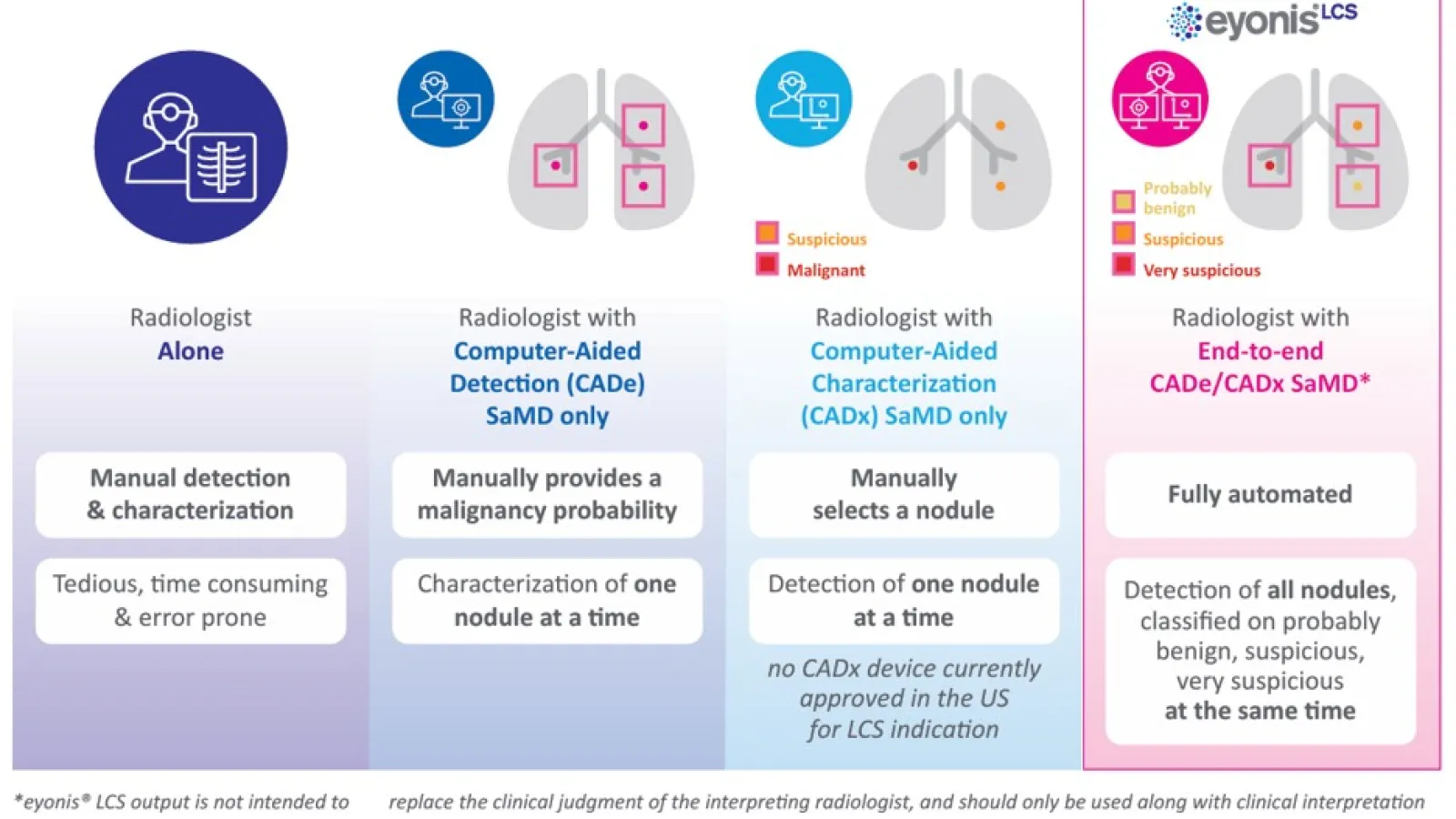
eyonis LCS received FDA clearance in February 2026 and CE marking in July 2026. The company describes it as the first FDA-cleared Software as a Medical Device (SaMD) to combine both pulmonary nodule detection and malignancy likelihood assessment in a single workflow on low-dose CT. Most competing AI-assisted tools currently address detection only, leaving clinicians to rely on separate processes for diagnostic characterisation.
Clinical evidence
Data submitted as part of the FDA clearance process came from a multireader, multicase study. According to Eyonis, radiologists using eyonis LCS achieved sensitivity of 93.3% against 80.3% without the tool, and specificity of 92.4% compared with 76.4% unassisted. The company reported that those gains translated to 66% fewer false-negative interpretations and 68% fewer false-positive interpretations. Overall, 75% of radiologists in the study improved their diagnostic performance when working with the software rather than reading manually. The study met all primary clinical and regulatory endpoints.
Oran Muduroglu, President of Eyonis, said the partnership with Canon Medical and Olea Medical would bring the capability "directly to healthcare providers," adding that the tool is designed to help radiologists identify patients needing timely intervention while reducing the burden from indeterminate findings.
The clinical rationale is straightforward: lung cancer diagnosed at an early stage carries an 80% twenty-year survival rate, yet only around 16% of lung cancers are currently caught at that stage, leaving the average five-year survival rate across all patients at roughly 19%. The standard watchful-waiting interval of three to six months for suspicious but inconclusive nodules risks disease progression to a less treatable stage, making earlier diagnostic clarity a meaningful clinical objective.
Market context
The AI-assisted radiology market for lung cancer screening is growing rapidly. US screening rates have increased since updated guidance from the US Preventive Services Task Force expanded the eligible population, and several healthcare systems are under pressure to process higher volumes of low-dose CT scans without proportionally expanding radiology headcount. That dynamic has attracted a range of vendors offering computer-aided detection tools, including both dedicated SaMD developers and larger imaging platform providers building AI modules into existing reading workflows.
Eyonis' combined detection and diagnosis positioning sets it apart from CADe-only products, but clinical adoption will depend on how well eyonis LCS integrates with existing picture archiving and communication systems. The company says the product is designed for compatibility with standard hospital PACS environments, which lowers one common barrier to adoption. The Olea Medical channel is a meaningful commercial step: Canon Medical's CT installed base in US radiology gives Olea access to the precise organisations most likely to be building out screening capacity, rather than requiring Eyonis to develop those relationships independently.
Median Technologies is listed on Euronext Growth Paris under the ticker ALMDT. The financial terms of the distribution agreement were not disclosed.