
Z Optics presents six-month IOL data at ESCRS 2026

Z Optics Inc. has shared six-month clinical results for its Z+ Virtual Aperture intraocular lens (IOL) at the 44th Congress of the European Society of Cataract and Refractive Surgeons (ESCRS), held in London in September 2026. The data, drawn from a single-centre Mexican study, represent the most substantive clinical disclosure the Reno-based company has made for an investigational device that remains unavailable for commercial sale in any market.
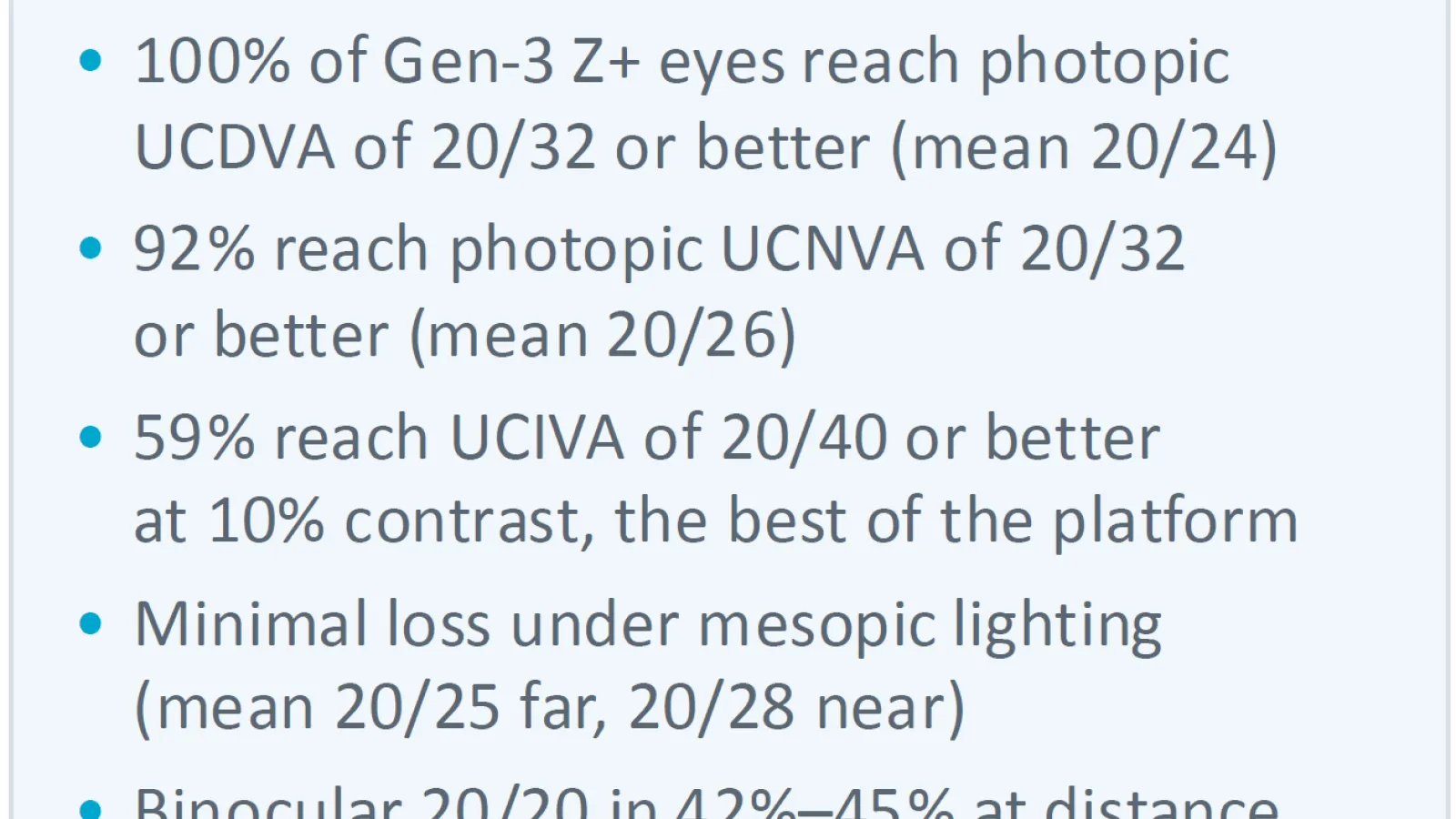
The study enrolled 43 patients (86 eyes), all of whom received the Z+ IOL bilaterally. The headline figures relate to 38 eyes implanted with the third-generation lens design. At six months, all of those eyes achieved uncorrected distance vision of 20/32 or better in daylight, with a mean of 20/24. For near vision, 92 per cent reached 20/32 or better, averaging 20/26. Performance under mesopic conditions, which simulates low-light environments relevant to night driving, was reported as mean uncorrected acuity of 20/25 at distance and 20/28 at near: a modest reduction from daylight performance that the presenting investigator characterised as clinically meaningful.
Safety and patient-reported outcomes
No serious adverse events were recorded across the six-month follow-up. The absence of halos was complete: every patient in the cohort reported none. Glare was reported as absent in 79 per cent of patients, mild in 18 per cent, and moderate in 3 per cent. Corneal endothelial cell density averaged 2,475 cells per square millimetre, a figure within normal post-operative ranges and consistent with preserved corneal health.
Lead investigator Dr Francisco Sánchez León of Novavision Laser Center in Naucalpan, Mexico, described the consistency of the results as notable, telling the ESCRS audience that the combination of functional near-to-distance range and maintained night vision represented a capability not previously available to surgeons. He characterised the outcome as "multifocal visual acuity with monofocal clarity."
The technology underlying the lens is distinct from standard multifocal designs. Rather than splitting incoming light between multiple focal points, the Z+ uses a 2.8 mm central optic surrounded by what the company calls a geometric virtual aperture zone, which redirects out-of-focus light away from the central retina. Z Optics says this raises contrast and signal-to-noise ratio and produces a continuous depth of focus, while avoiding the halos and glare that have driven surgeon and patient dissatisfaction with conventional multifocal IOLs.
Market context and competitive landscape
The premium IOL market is actively contested. Established players including Alcon, Johnson and Johnson Vision, and Carl Zeiss Meditec have each brought extended depth-of-focus (EDOF) designs to market, and several have reported halos or reduced contrast as trade-offs for extended range. Surgeon-reported concerns about visual quality in challenging lighting have remained a persistent commercial limiting factor for the multifocal and EDOF categories, which is the competitive gap Z Optics is positioning its virtual aperture approach to fill.
Whether a 38-eye, single-centre dataset from a single investigator is sufficient to substantiate those positioning claims remains an open question. The company acknowledged as much by disclosing that a multicenter European study, with sites in Switzerland, Spain, and Portugal, is under way. Results from that broader programme have not yet been released, and the device currently carries investigational status only.
For surgeons and procurement committees evaluating premium IOL options, the ESCRS dataset is an early signal rather than a definitive evidence base. The European multicentre readout will be the more consequential clinical event, and its design, powered endpoints, and comparator arms have not been disclosed. Regulatory submissions in the EU or the US would require data substantially beyond what has been published to date.