
Kraig Biocraft completes Atlas Gene Library in silkworm hosts

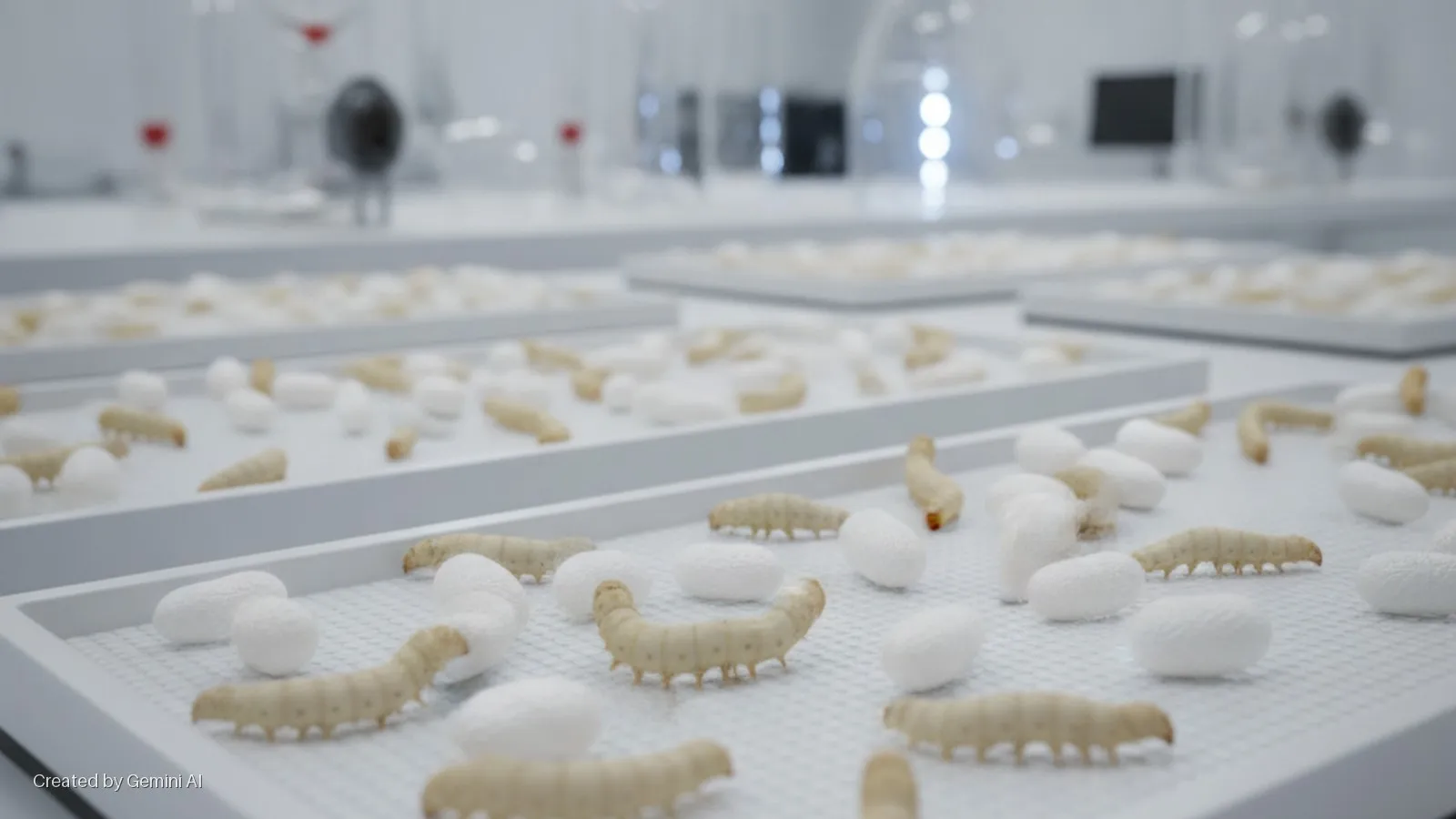
Kraig Biocraft Laboratories has announced the completion of its Project Atlas Gene Library, confirming that every planned Atlas transgene has been integrated into living commercial silkworm hosts. The OTCQB-listed company says this sets the stage for systematically combining those genetic elements to produce fibres with enhanced strength, toughness, and flexibility beyond its existing recombinant spider silk output.
The milestone is framed as foundational rather than commercial. Kraig now holds what it describes as the full planned set of genetic building blocks inside a viable production organism, giving its scientists the starting point to test combinations at scale.
What Project Atlas targets
Spider silk has attracted serious materials science interest for decades. Research published in PLOS ONE by Agnarsson, Kuntner and Blackledge in 2010 recorded average toughness of approximately 350 MJ/m³ for Darwin's bark spider silk, with peak samples reaching 520 MJ/m³ and a comparison of more than ten times the toughness of Kevlar by energy absorption. That benchmark has driven ongoing efforts to replicate or approach this performance in a manufacturable system.
Kraig's Atlas programme is designed to explore more than 200 potential genetic configurations. Its stated objective is to combine the full Atlas suite into a single production strain, though the company is clear that testing will be required to identify which combinations yield useful material properties. Dr Xiaoli Zhang, Kraig's Chief Scientist, said: "Every planned Atlas transgene has now been established in commercial silkworm hosts, giving us the complete set of genetic building blocks we envisioned when Project Atlas began."
The next stated phase is establishing stable homozygous breeding lines carrying matching copies of the relevant genetic inserts. These lines would provide the basis for systematic assembly and fibre evaluation, with performance measurement and candidate selection following as downstream milestones.
Market landscape and editorial context
The engineered biomaterials sector remains largely pre-commercial, with a number of companies and university-spinout groups pursuing high-performance protein fibres derived from spider silk or analogous structural proteins. Approaches range from fermentation-based expression in yeast or bacteria to the silkworm-based transgenesis that Kraig has pursued. None has yet demonstrated large-scale commercial viability at commodity cost points, and the gap between laboratory performance and manufacturable consistency remains the central challenge across the field.
Kraig's use of silkworms as a production host is a structurally different bet from microbial fermentation routes: silkworms naturally spin protein fibres, which theoretically reduces downstream processing steps, but scaling breeding lines introduces its own biological complexity. The company notes that Atlas is advancing in parallel with existing commercial spider silk operations, suggesting it is not pausing revenue-generating activity to run the programme.
Investors should note that this release originated via a paid third-party investor relations service, 24/7 Market News, which discloses share ownership in Kraig Biocraft. The substantive scientific claims are consistent with the company's prior disclosures on Project Atlas, but the promotional framing warrants caution. Near-term milestones to watch are the establishment of stable homozygous lines and any published or presented fibre performance data.