
BeyondSpring plinabulin triple shows durable NSCLC benefit

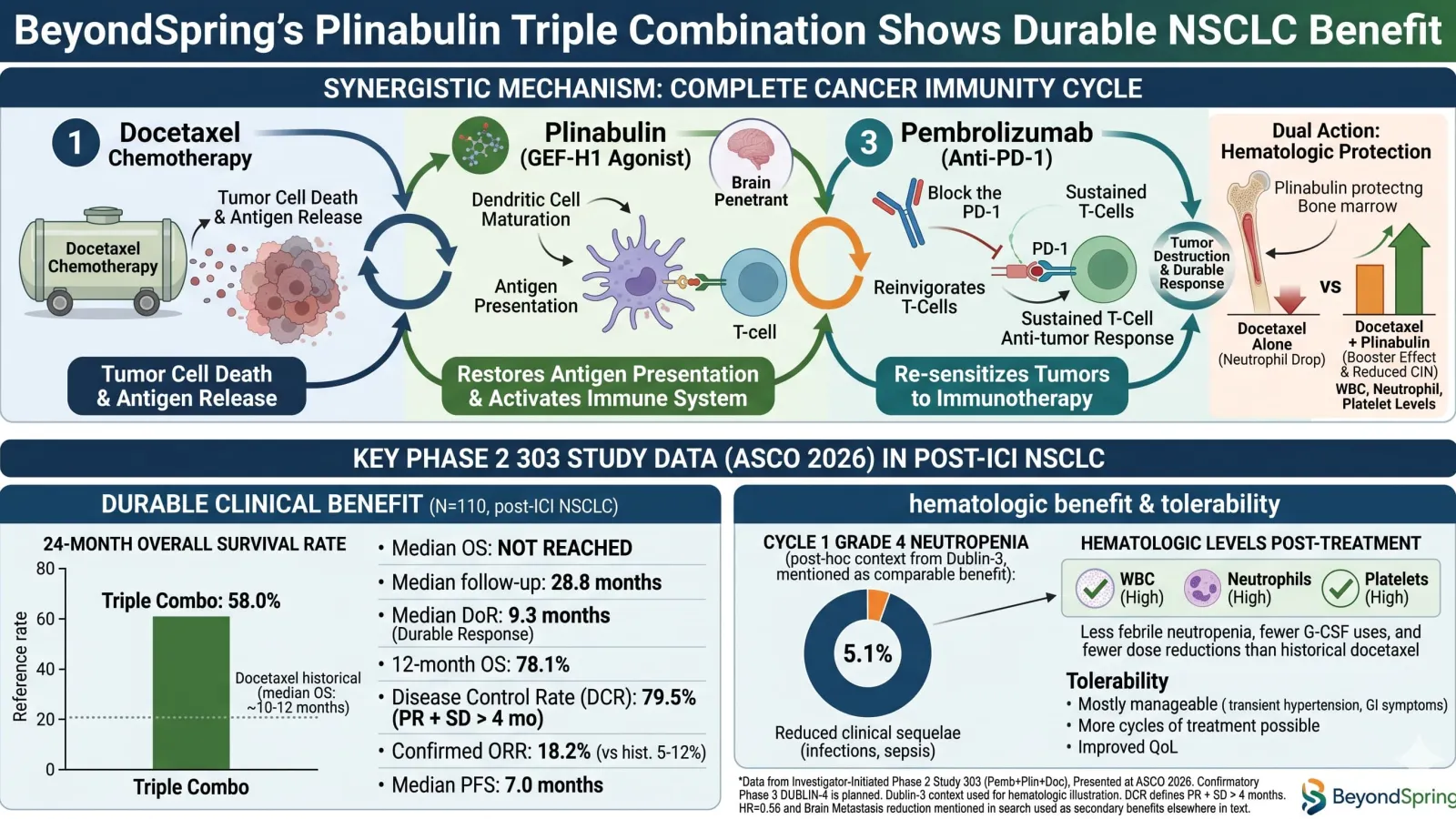
BeyondSpring has presented updated efficacy and safety data from its investigator-initiated Phase 2 303 Study at the 2026 ASCO Annual Meeting, showing durable clinical benefit from a triple combination of pembrolizumab, plinabulin, and docetaxel in metastatic non-small cell lung cancer patients who had progressed on prior immune checkpoint inhibitor therapy.
The data, presented by principal investigators Dr Mengzhao Wang and Dr Yan Xu from Peking Union Medical College Hospital in Beijing, covered 47 enrolled patients with secondary resistance to PD-1/L1 inhibitor-based regimens, defined as prior ICI treatment with at least six months of progression-free survival before relapse. Median follow-up at the 28 February 2026 data cutoff was 28.8 months.
Key efficacy findings
Median progression-free survival came in at 7.0 months, and the disease control rate — comprising partial responses and stable disease lasting more than four months — was 79.5%. The confirmed objective response rate was 18.2%, which the company says compares favourably with a historical 5–12% ORR for docetaxel in similar populations. Median duration of response was 9.3 months, and the 24-month overall survival rate reached 58.0%, with median OS not yet reached. BeyondSpring drew comparisons with the TROPION-Lung01 and EVOKE-01 trials, which reported median OS of 11.8 months and 9.8 months respectively in post-ICI NSCLC cohorts.
On safety, 53.2% of patients experienced grade 3 or higher treatment-related adverse events, including hypertension and neutrophil decrease in 17.0% each, and gastrointestinal disorders in 14.9%. The rate of febrile neutropenia, a significant concern with docetaxel-based regimens, was 2.1%.
Dr Wang said the 24-month OS rate of 58%, alongside roughly 80% disease control and signs of immune activation, suggested plinabulin "may offer a differentiated approach to re-sensitising tumours to immunotherapy with durable long-term benefit while improving the therapeutic profile of docetaxel-based regimens."
Market context and competitive positioning
Post-ICI NSCLC remains one of the most contested and commercially significant unmet-need segments in oncology. Approved options after checkpoint inhibitor failure are limited, and single-agent docetaxel — the standard of care in many markets — has delivered modest outcomes. Antibody-drug conjugates, including datopotamab deruxtecan and others targeting TROP-2 or HER2, are advancing through this space, as are novel immunotherapy combinations, making the post-ICI setting increasingly crowded.
Plinabulin's proposed mechanism as a GEF-H1 agonist with dendritic cell maturation activity gives it a scientifically distinct rationale compared with ADCs and pure checkpoint combinations, though this remains Phase 2-stage data from a single-centre, open-label, single-arm study. Without a randomised control arm, the cross-trial comparisons BeyondSpring draws with TROPION-Lung01 and EVOKE-01 carry inherent methodological limitations that regulatory agencies and clinicians will weigh carefully.
The 303 Study was funded through Merck's Investigator Studies Program and BeyondSpring, with Merck providing study drug and financial support — a collaboration worth noting given the inclusion of pembrolizumab in the regimen. BeyondSpring has not announced a pivotal trial design or regulatory submission timeline on the back of this data, and the path to a registrational programme in this indication remains to be defined.