
Cardiff Oncology: onvansertib hits 72% ORR in RAS-mutated mCRC

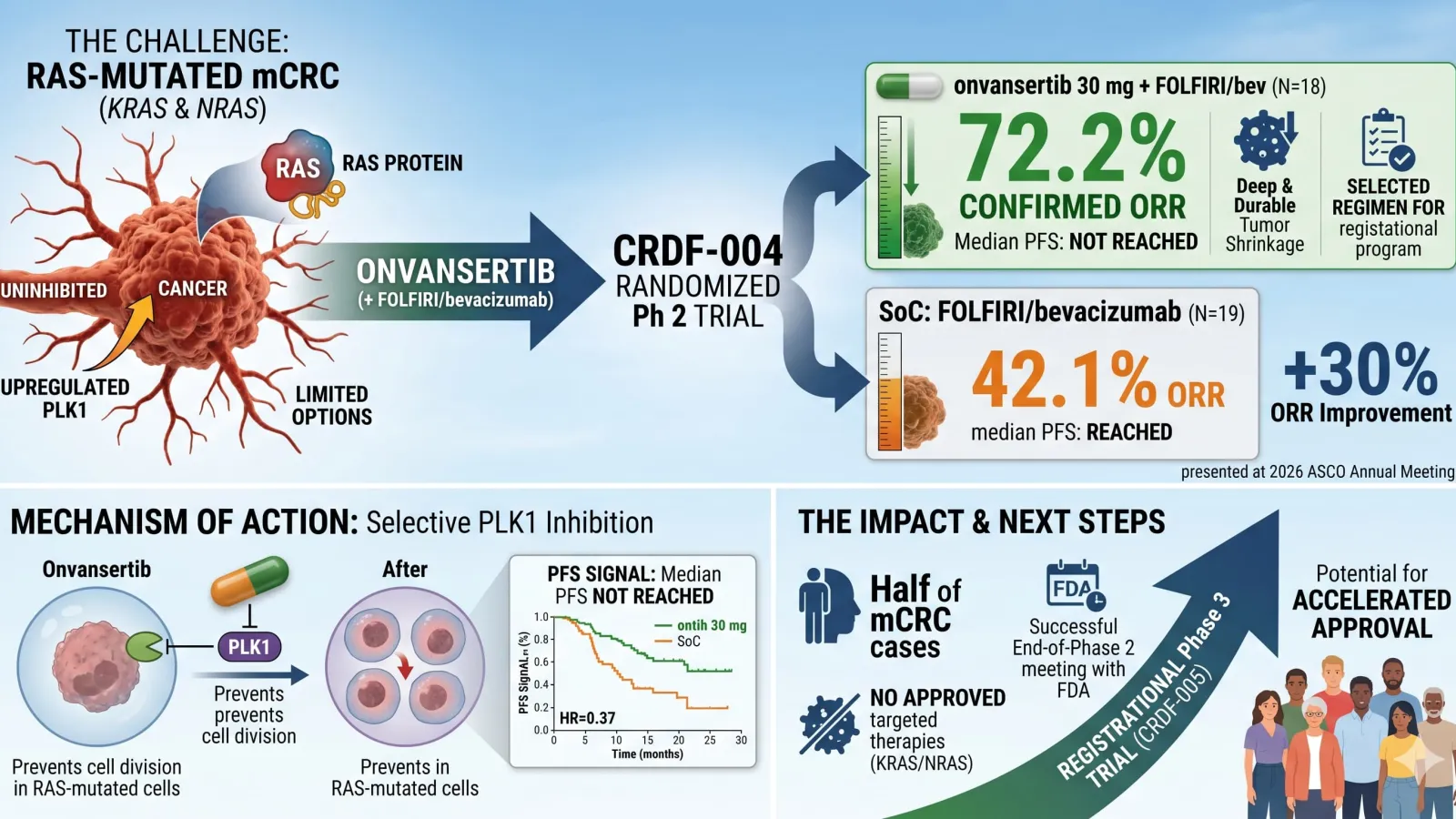
Cardiff Oncology has reported updated results from CRDF-004, its randomised, controlled Phase 2 trial of onvansertib in first-line RAS-mutated metastatic colorectal cancer (mCRC), showing a confirmed objective response rate (ORR) of 72.2% in the 30 mg onvansertib plus FOLFIRI/bevacizumab arm against 42.1% for standard-of-care (SoC) alone — a 30 percentage-point improvement. The data were presented in a rapid oral session at the 2026 ASCO Annual Meeting in Chicago.
Median progression-free survival (PFS) has not yet been reached in either the 20 mg or 30 mg onvansertib arms combined with FOLFIRI/bevacizumab, while the PFS endpoint has been reached in both SoC arms. The PFS hazard ratio for the 30 mg arm versus FOLFIRI/bev was 0.55 (95% CI: 0.15–2.09) by blinded independent central review. Four patients remain on treatment beyond 15 months, including two beyond 20 months. The wide confidence intervals reflect the trial's dose-finding intent and relatively small cohort sizes; the registrational study will be adequately powered to resolve this.
Trial design and regulatory path
CRDF-004 enrolled patients across six arms, evaluating two doses of onvansertib alongside FOLFIRI/bevacizumab or FOLFOX/bevacizumab. No meaningful efficacy benefit was observed in the FOLFOX combination arms. Based on the totality of the Phase 2 evidence, Cardiff has selected onvansertib 30 mg plus FOLFIRI/bevacizumab as the dose and regimen for a global registrational Phase 3 trial.
Critically, Cardiff says it has completed an End-of-Phase 2 meeting with the FDA and aligned on the Phase 3 design. That alignment removes a significant regulatory uncertainty and is the most commercially meaningful disclosure in this release.
Heinz-Josef Lenz, associate director for clinical research at the USC Norris Comprehensive Cancer Center, who presented the data, noted that RAS-mutated mCRC remains largely without targeted options: "There are currently no treatment options specifically approved for patients with RAS-mutated mCRC — except for KRAS G12C mutations, which account for less than 4% of all colorectal cancers."
Market context and competitive landscape
RAS mutations — principally KRAS and NRAS — are present in approximately 50% of all colorectal cancer cases, making the addressable population substantial. The space has historically been defined by resistance to EGFR inhibitors, leaving FOLFIRI/bevacizumab as the default first-line backbone with limited differentiation.
Onvansertib targets PLK1 (polo-like kinase 1), a mitotic regulator with documented synthetic lethality in RAS-driven tumours. The mechanism is distinct from the KRAS G12C-specific inhibitors — such as sotorasib and adagrasib — that have reached the market in lung cancer and are now being evaluated in colorectal indications, albeit with more modest response rates in CRC than in NSCLC. If the Phase 3 trial reproduces the ORR and PFS signal seen in CRDF-004, onvansertib would represent the first broadly applicable targeted addition to first-line mCRC therapy for RAS-mutated patients.
Several PLK1 inhibitors have failed in earlier development cycles; Cardiff's data are notable for showing tolerability alongside efficacy in the combination setting, with neutropenia as the most common Grade 3+ event and no additive toxicities reported.
Mani Mohindru, Cardiff's president and chief executive, described the company as "highly encouraged by the consistent efficacy seen with onvansertib in combination with FOLFIRI/bev across two clinical trials." The company plans to provide further details on the registrational study design in coming months and held an investor webcast on 3 June 2026.
The next material milestone for investors will be the Phase 3 trial initiation date and the first interim analysis, likely 18 to 24 months from enrolment completion.