
Disc Medicine RALLY-MF data show broad anemia responses in MF

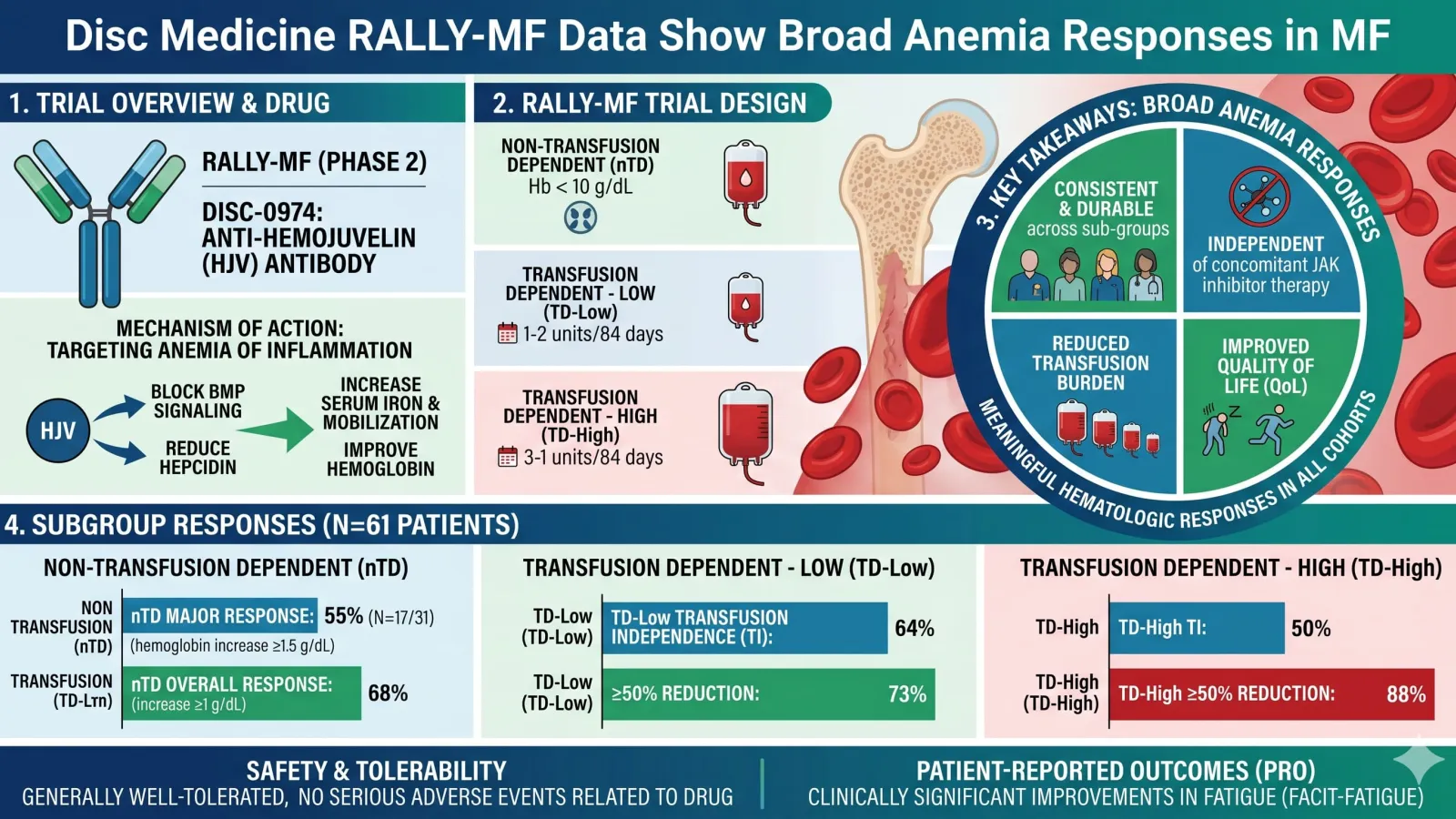
Disc Medicine has presented updated data from its RALLY-MF Phase 2 trial of DISC-0974 at the 2026 ASCO Annual Meeting in Chicago, reporting meaningful and durable anemia responses across patient subgroups in myelofibrosis — regardless of transfusion dependence or concurrent use of a JAK inhibitor.
The Watertown, Massachusetts-based company (NASDAQ: IRON) reported results from 50 evaluable patients — drawn from 61 enrolled as of the 27 April data cutoff — stratified by transfusion burden at baseline. DISC-0974, a hepcidin-suppressing antibody administered subcutaneously at 50 mg every four weeks, produced greater than 75% reductions in hepcidin from baseline alongside corresponding increases in serum iron across cohorts.
Trial results
Among non-transfusion-dependent patients (nTD, n=31), 55% achieved a haemoglobin increase of at least 1.5 g/dL sustained for 12 or more weeks — defined as a major response — with 68% meeting the broader overall response threshold of at least 1 g/dL for 12 weeks. In the low-transfusion-burden group (TD Low, n=11), 64% achieved transfusion independence over 16 weeks, while 73% reduced transfusion requirements by at least 50%. Results were similarly encouraging in the high-burden cohort (TD High, n=8): half achieved transfusion independence over 12 weeks, and 88% reduced transfusion requirements by 50% or more.
The company said response rates were consistent whether or not patients were receiving a concomitant JAK inhibitor, with 56% of that subgroup achieving a major haematologic response and 72% an overall response. Patient-reported outcomes, including FACIT-Fatigue scores, showed clinically meaningful improvements in nTD and TD Low participants, with improvements correlating with haemoglobin change.
President and chief executive John Quisel, J.D., Ph.D., said: "The activity observed both with and without background JAK inhibitor therapy, together with improvements in transfusion burden and fatigue, continues to support the potential for DISC-0974 to serve a broad population of patients living with MF-associated anemia, an area where substantial unmet need remains."
On safety, DISC-0974 was generally well-tolerated. Diarrhoea — not considered serious — was the only treatment-related adverse event reported in two or more patients. Disc said additional RALLY-MF data are expected in the fourth quarter of 2026, with an end-of-Phase 2 meeting with the FDA anticipated by year-end.
Market context and competitive landscape
Myelofibrosis-associated anaemia represents a persistent unmet need in haematology. Current standard-of-care JAK inhibitors — ruxolitinib and fedratinib among others — address splenomegaly and constitutional symptoms but have limited impact on anaemia, and some can exacerbate it. The independence of DISC-0974's anaemia responses from JAK inhibitor background therapy is therefore a commercially important differentiator: it positions the candidate as a potential add-on rather than a replacement, broadening the addressable patient population.
The hepcidin pathway is an increasingly validated target in haematological disease. Luspatercept (Bristol Myers Squibb and Merck), an erythroid maturation agent approved in myelodysplastic syndromes and beta-thalassaemia, operates on an overlapping biology, and its real-world uptake has helped establish clinician familiarity with newer anaemia mechanisms beyond erythropoiesis-stimulating agents. Disc's differentiation argument rests on DISC-0974 acting upstream via hepcidin suppression to mobilise iron stores — a distinct mechanism that, if the Phase 3 data hold, could complement rather than compete with existing options.
The forthcoming FDA end-of-phase meeting will be a critical inflection point, setting the design parameters for a pivotal trial and informing the regulatory timeline toward a potential NDA. Investors will watch closely for clarity on the primary endpoint definition, trial size, and whether accelerated approval pathways are in scope given the strength of the Phase 2 signal.