
Fractyl Health: Revita holds 78% of GLP-1 weight loss at one year

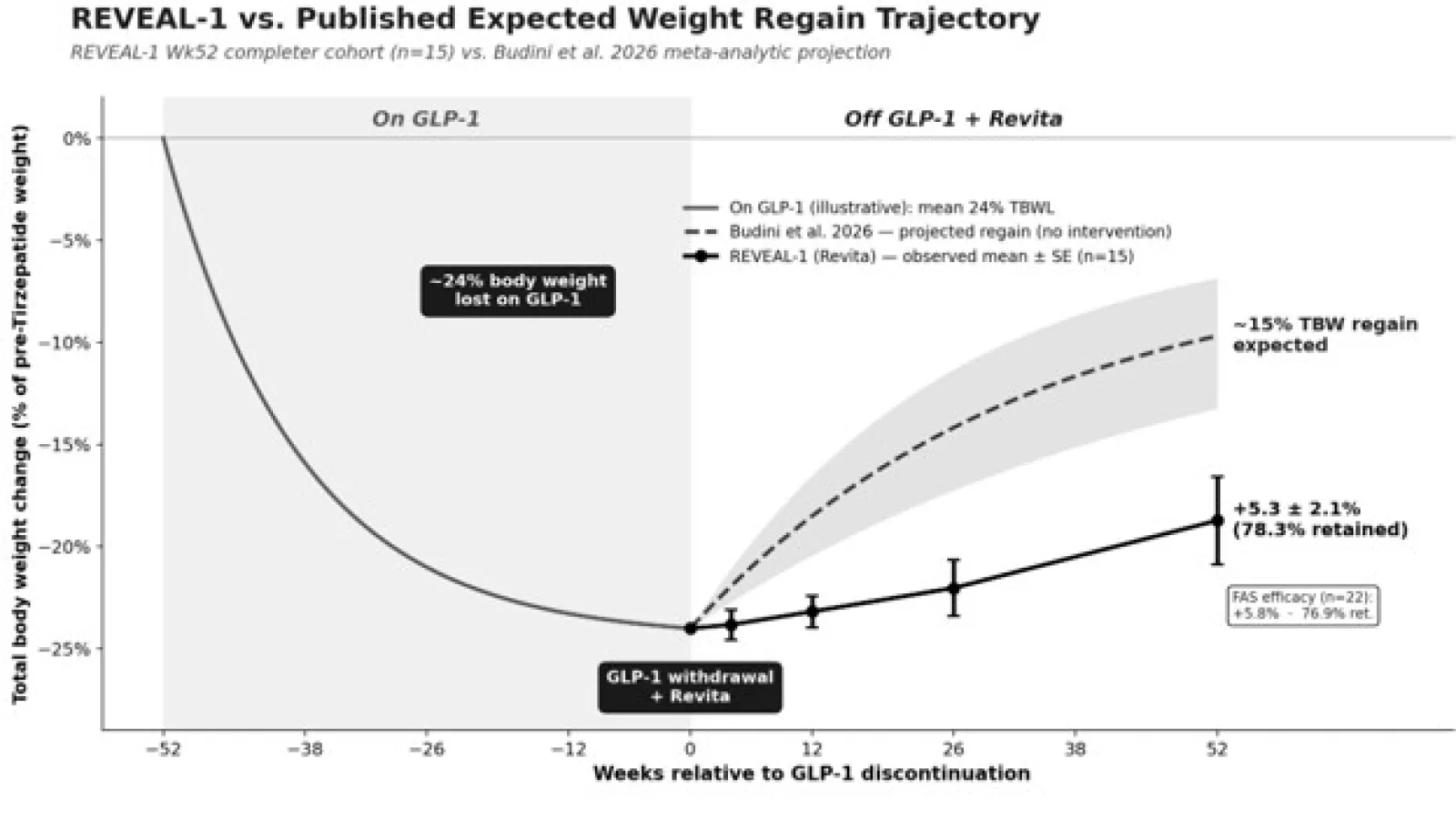
Fractyl Health has reported one-year results from the open-label REVEAL-1 cohort, showing that a single Revita endoscopic procedure helped patients retain approximately 78% of the weight they had lost on GLP-1 therapy, one year after stopping the drug. The NASDAQ-listed company said that 33% of participants continued to lose further weight over that period, and that all 22 participants in the safety population maintained at least 5% of their prior GLP-1-induced weight loss — the responder threshold used as a co-primary endpoint in the company's ongoing pivotal trial.
The REVEAL-1 cohort enrolled individuals who had lost a minimum of 15% of total body weight on a GLP-1 medicine before discontinuing therapy. Participants had a mean weight loss of roughly 24% — exceeding 50 pounds on average — while on the drug, with prior treatment durations ranging from five months to five years. The mean total body weight change one year after the Revita procedure was 5.3% (±2.1%, n=15 efficacy-evaluable participants), compared with approximately 15% weight regain at comparable time points reported in third-party GLP-1 withdrawal studies cited by the company. Glycaemic control also held: HbA1c rose by just 0.08 percentage points, versus a roughly 0.4 percentage point increase observed after GLP-1 withdrawal in the STEP-1 trial extension.
What Revita does
Revita is an endoscopic, catheter-based device that ablates and remodels the mucosal lining of the duodenum. The mechanism is grounded in the duodenum's role in nutrient sensing and metabolic signalling — disruption of which is considered a contributor to obesity and type 2 diabetes. Fractyl describes the procedure as a one-time intervention designed to restore normal signalling pathways, positioning it as distinct from chronic pharmacological management. The device holds FDA Breakthrough Device designation for weight maintenance in people with obesity who discontinue GLP-1 therapy, and is CE marked in the EU and UK for investigational use.
Shailendra Singh, Director of Bariatric Endoscopy at West Virginia University, said the duodenal approach and tolerability profile — comparable to routine upper endoscopy — made Revita a procedural option that "could fit naturally into how we care for these patients."
Market context and competitive positioning
The GLP-1 weight-loss market is now dominated by semaglutide and tirzepatide, with multiple next-generation entrants in late-stage development. The well-documented rebound effect after discontinuation — driven by commercial access, side effects, or cost — has created a clinically recognised gap that several companies are targeting. Bariatric endoscopy more broadly remains a relatively niche subspecialty, but the scale of the GLP-1 prescribing base means even a modest conversion rate could represent a sizeable addressable population.
Fractyl's most immediate competitive question is whether randomised controlled data will replicate the open-label signal. The company acknowledged that REVEAL-1 was not powered to detect a dose-response relationship with ablation length. Pivotal validation rests on REMAIN-1: one-year randomised data from its midpoint cohort are anticipated in the third quarter of 2026, with topline six-month randomised data from the pivotal cohort expected in early Q4. Those readouts will be closely scrutinised by investors and clinicians alike, given that open-label cohorts without an untreated comparator arm cannot rule out lifestyle-programme effects or natural weight stabilisation.
Fractyl's pipeline also includes Rejuva, an AAV-based gene therapy programme with its lead candidate RJVA-001 entering first-in-human studies, though this remains early stage and was not the focus of the current release. For now, REMAIN-1 pivotal readouts represent the company's most consequential near-term catalyst.