
Vascudyne lab-grown bypass vessel sustains flow at two-year mark

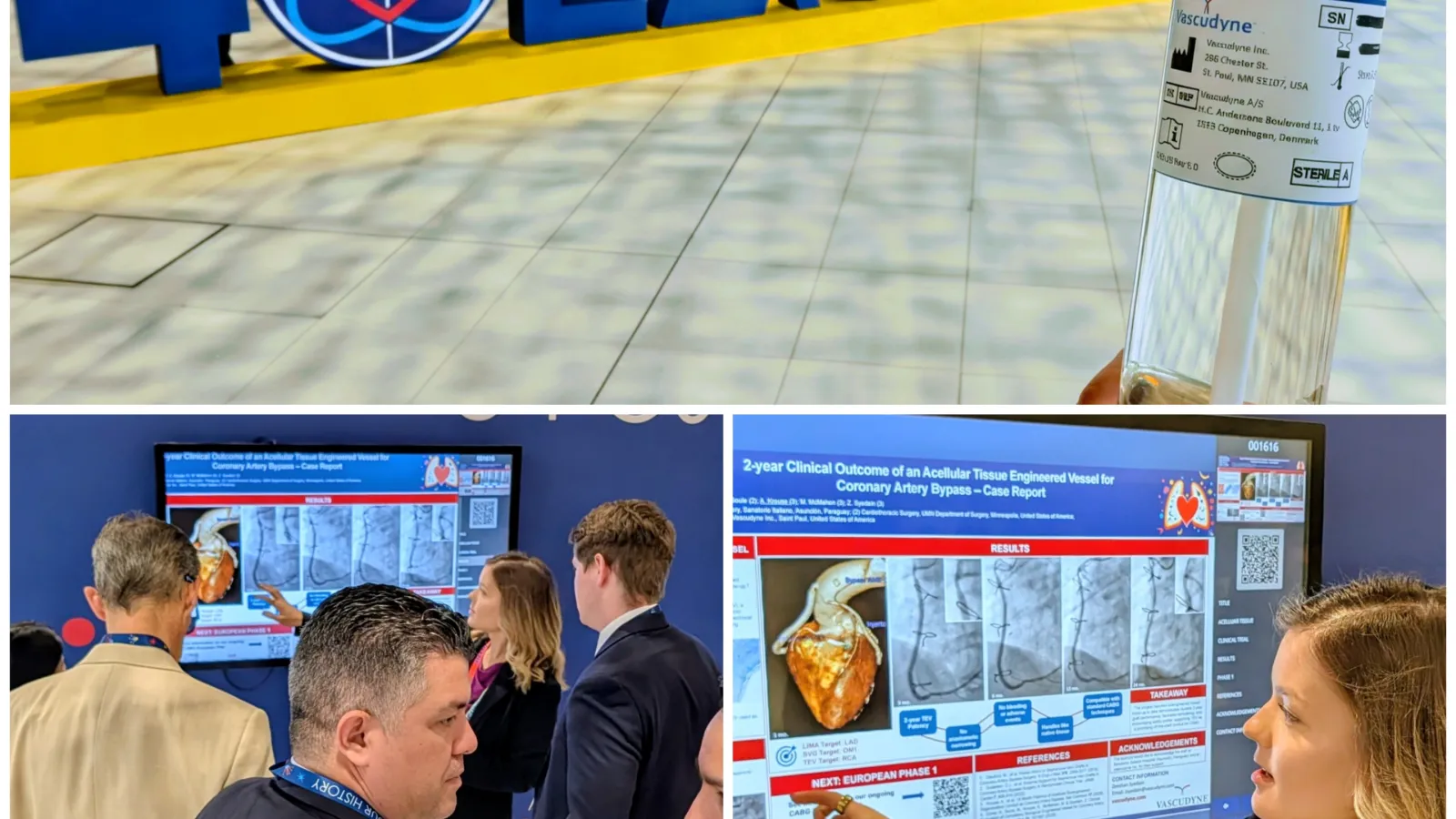
Vascudyne has reported that a patient who received one of its laboratory-grown blood vessels during coronary artery bypass grafting (CABG) has maintained unobstructed blood flow for two years, with no clotting, graft aneurysm, bleeding or major cardiac event recorded throughout follow-up. The single-patient case, presented at the 40th EACTS Annual Meeting in Barcelona on 8 October, represents the longest clinical patency the company has documented for its tissue-engineered vessel.
Conventional CABG relies on harvesting a vessel from the patient, typically the saphenous vein in the leg, which introduces a second wound, extends recovery and carries meaningful failure rates. The company cites published figures suggesting roughly one in five patients lacks a suitable vein, and that many harvested veins narrow or occlude within the first year. Vascudyne's approach uses human tissue grown in a bioreactor from which all cells are subsequently removed, leaving a collagen-based scaffold that can be stored on a hospital shelf until needed. After implantation, the patient's own cells progressively colonise the scaffold, theoretically converting it into living, integrated tissue without the need for immunosuppression.
Preclinical evidence strengthens the regeneration story
Alongside the clinical report, Vascudyne published 18-month ovine data in Nature Communications, in which bioengineered vessels used as coronary bypass grafts remained patent after anticoagulation therapy was withdrawn. Histological analysis at explant confirmed endothelialisation: the grafts had grown a functional inner lining of endothelial cells, the layer that prevents thrombosis in native vessels. The company describes this as the first published demonstration of endothelialisation in lab-grown cardiac grafts that subsequently remained open for a full year after blood thinners were discontinued. That combination of functional patency and histological evidence of biological integration is the crux of the value proposition for the platform.
Chief executive Zeeshan Syedain said the two-year clinical result and the 18-month animal data together were "very promising" and that the company believed its technology had "the potential to transform not only coronary bypass surgery, but many cardiovascular diseases." Vascudyne also confirmed it has completed enrolment in its European CABG feasibility study, a meaningful procedural milestone though not yet a pivotal dataset.
Market and competitive context
The off-the-shelf small-vessel graft market has long been regarded as a significant unmet need in cardiac surgery. Synthetic grafts made from expanded polytetrafluoroethylene (ePTFE) or Dacron perform adequately in large-diameter applications such as aortic reconstruction, but have not replicated those outcomes in small-calibre vessels below approximately 6 mm, where the coronary circulation sits. Several tissue-engineering programmes have pursued similar decellularised or biopolymer approaches over the past decade, including academic spinouts in Europe and North America, though none has yet achieved regulatory approval for coronary use.
Vascudyne's investigational devices remain unapproved for commercial use. The European feasibility study will need to mature into a controlled, adequately powered trial before any regulatory submission is realistic, and single-patient clinical reports, however encouraging, carry inherent limitations in generalisability. Investors and cardiac surgeons will be watching for cohort-level data from the European study, a defined regulatory pathway discussion with the FDA or a European notified body, and longer-term durability signals in the ovine model before the platform can be fully assessed. The company is additionally developing the technology for paediatric cardiac defect repair and heart valve replacement, which broadens the addressable market but also the development risk.