
J&J nipocalimab meets Phasea 2 primary endpoint in lupus study

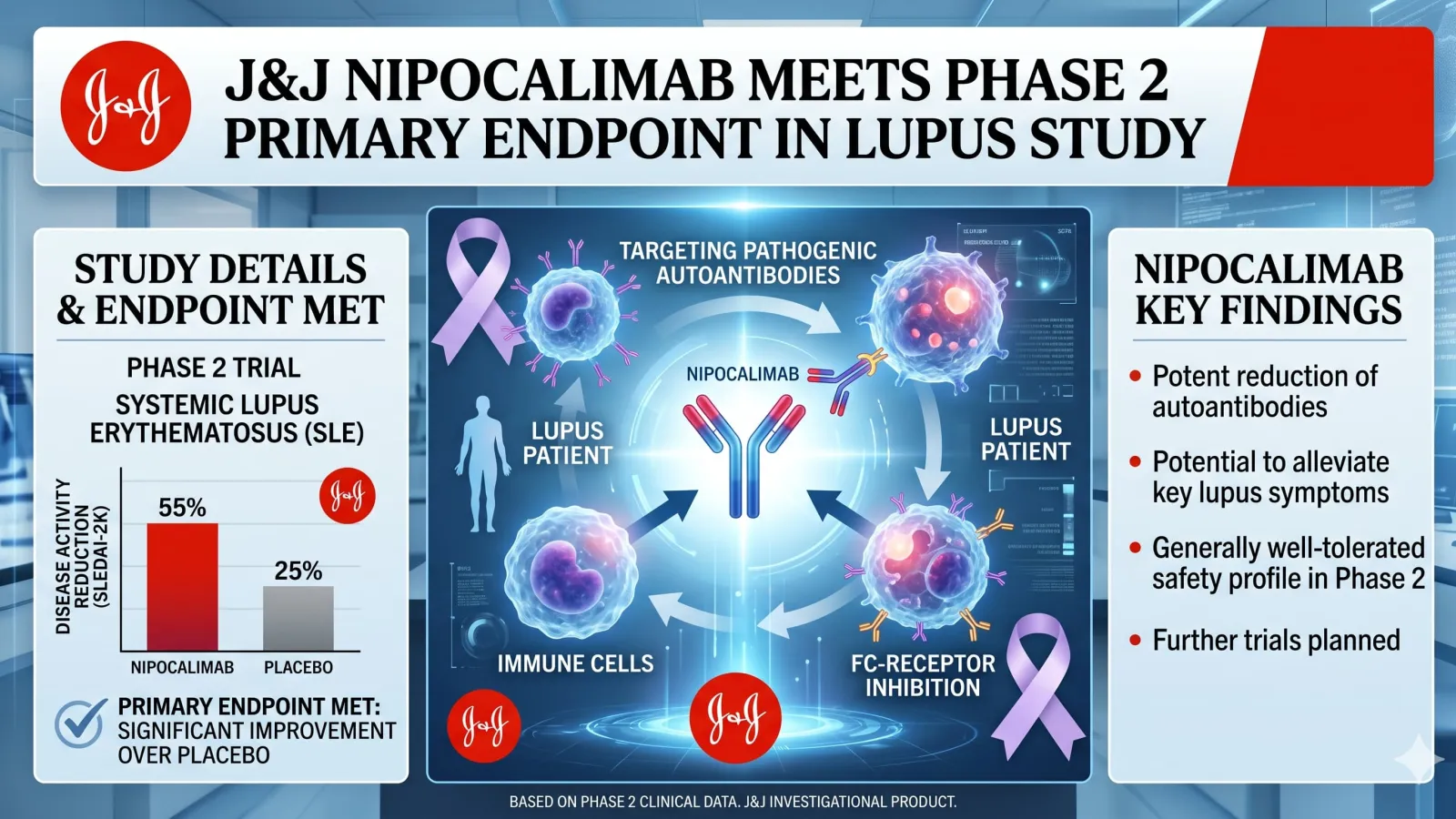
Johnson & Johnson has reported that nipocalimab, its investigational neonatal Fc receptor (FcRn) blocker, met the primary endpoint of the Phase 2 JASMINE study in adults with moderate-to-severe systemic lupus erythematosus (SLE), with sustained reductions in disease activity observed through 52 weeks. The data were presented as a late-breaking abstract at the European Alliance of Associations for Rheumatology (EULAR) 2026 Congress in London.
The study enrolled 228 adults and randomised participants 1:1:1 to receive intravenous nipocalimab at 5 mg/kg, 15 mg/kg, or placebo every two weeks, on top of background standard-of-care therapy. At the primary endpoint of 24 weeks, 53.5% of patients in the 15 mg/kg arm achieved an SRI-4 response — a validated composite measure of SLE disease activity — versus 46.7% in the placebo group, with an odds ratio of 1.6 (90% CI: 0.9–2.9; p=0.081). At Week 52, 53.6% of patients in the nipocalimab 15 mg/kg group achieved SRI-4 response compared with 39.7% in the placebo arm (p=0.020).
The more pronounced signal emerged in a pre-defined autoantibody-positive subpopulation, which represents approximately 80% of people living with SLE. In this cohort, SRI-4 response rates at Week 52 were 58.2% versus 36.1% for placebo (p=0.004), and achievement of Lupus Low Disease Activity State (LLDAS) was 38.9% versus 18.0% (p=0.012). J&J describes JASMINE as the first clinical proof-of-concept for FcRn blockade in SLE.
Clinical context
Richard Furie, Chief of the Division of Rheumatology at Northwell, said the 52-week findings "support the potential of nipocalimab to provide disease control over time for a broad population of autoantibody-positive adult patients living with moderate-to-severe systemic lupus erythematosus, a disease in which many patients experience ongoing disease activity and risk of irreversible organ damage." Furie has disclosed consulting, advisory and speaking relationships with J&J.
Nipocalimab's safety profile was described as consistent with earlier studies. The most frequently reported adverse events (occurring in 10% or more of patients) were nasopharyngitis, headache, urinary tract infection, and nausea; J&J said no new safety signals were identified. The drug is not currently approved by the European Medicines Agency for SLE.
The FDA granted nipocalimab Fast Track designation in SLE in January 2026, and J&J's Phase 3 GARDENIA study in the indication is already underway. The broader nipocalimab programme spans rheumatologic, rare autoantibody, and maternal-foetal disease settings; the FDA has also granted Priority Review in warm autoimmune haemolytic anaemia and Breakthrough Therapy designation for haemolytic disease of the foetus and newborn.
Competitive landscape
The FcRn blocker class has attracted significant commercial interest in autoimmune indications. UCB's rozanolixizumab and argenx's efgartigimod — both FcRn-targeting agents — have already achieved regulatory approvals in generalised myasthenia gravis, establishing proof that the mechanism can translate into marketed therapies. SLE, however, has historically been a graveyard for late-stage immunology programmes; only belimumab (GSK) and anifrolumab (AstraZeneca) have secured approvals in the indication within the past decade, and neither has displaced the large residual unmet need in refractory disease.
Nipocalimab's differentiation rests on its selectivity — the company describes it as "immunoselective" because it reduces circulating IgG, including pathogenic autoantibodies, while reportedly preserving immune function. Whether that profile translates to a cleaner benefit-risk picture than existing options will depend heavily on Phase 3 data from GARDENIA. Investors and clinicians will focus on whether the autoantibody-positive subgroup signal holds at scale and whether the LLDAS endpoint — increasingly favoured as a treat-to-target benchmark in SLE trials — can serve as a registrational primary in future studies. Full peer-reviewed publication of the JASMINE data has not yet been announced.