
Amplio Pharma Phase 1b data back NovoBioJect methotrexate booster

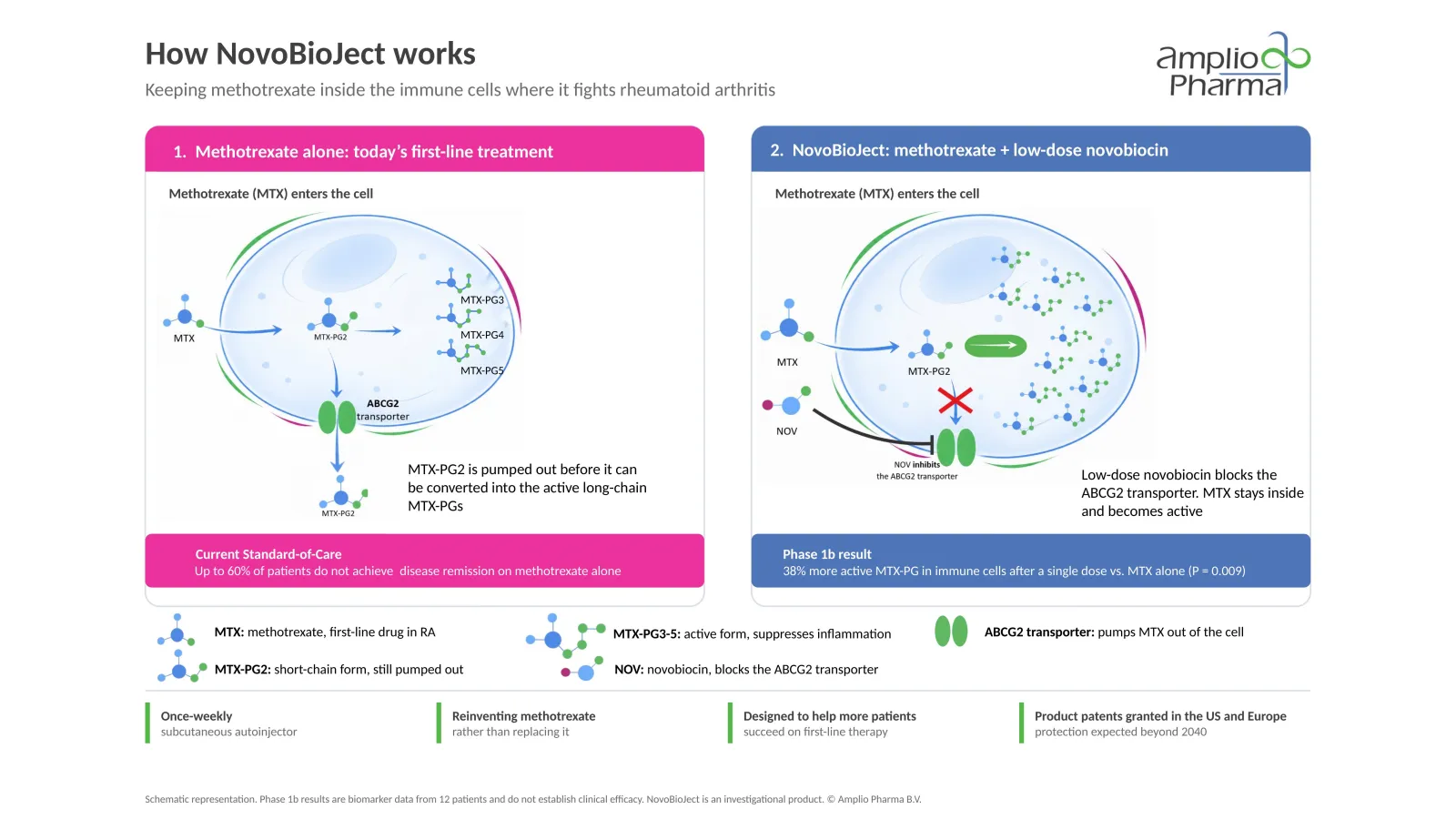
Amplio Pharma has reported positive results from a Phase 1b exploratory pharmacokinetic study of NovoBioJect, its fixed combination of low-dose methotrexate and novobiocin for rheumatoid arthritis. A single dose of the candidate produced a statistically significant 38% increase in intracellular accumulation of long-chain methotrexate polyglutamates, the pharmacologically active form of the drug, compared with methotrexate alone (P = 0.009). The study enrolled 12 patients already on stable weekly methotrexate and was conducted at the Centre for Human Drug Research in Leiden, the Netherlands.
The trial was not powered to establish clinical efficacy; its purpose was to test whether blocking the ABCG2 efflux transporter with low-dose novobiocin would retain more active methotrexate inside the peripheral blood mononuclear cells that drive joint inflammation. On that narrower mechanistic question, the company says the data are clear. The only adverse events observed were mild, dose-dependent injection-site reactions. Amplio has submitted the full dataset as a late-breaking abstract to ACR Convergence 2026.
The science and the unmet need
Methotrexate has been the global first-line standard of care in RA for more than four decades, prescribed to roughly four in five newly diagnosed patients. The problem, Amplio argues, is not the drug itself but the ABCG2 transporter, which pumps methotrexate out of target cells before it can be converted into its polyglutamated active form. The company cites published evidence that only around 40% of patients achieve remission on methotrexate monotherapy; the remaining 60% move to second-line biologics or targeted synthetic disease-modifying antirheumatic drugs, which carry higher safety risks and annual treatment costs exceeding $40,000 per patient in the United States.
Chief executive Marguérite Mensonides-Harsema said the study delivered "a clear read-out on the biomarker that matters," adding that the results give investors "a well-founded basis to move into a Phase 2a proof-of-concept study." External validation came from Joel Kremer, Pfaff Family Professor of Medicine at Albany Medical College and president of the Corrona Research Foundation, who described the approach as "scientifically compelling" and said the early data justify a well-designed Phase 2 study.
Financing and competitive context
Amplio is initiating a Series A financing round of approximately €10 million to fund a Phase 2a study comparing NovoBioJect with methotrexate alone in 100 newly diagnosed patients over 12 weeks in the Netherlands. Safety is the primary endpoint; secondary endpoints include clinical response rate, speed of onset, and MTX polyglutamate biomarkers. Subject to financing and regulatory approval, the company expects to start the study in 2027. Its earlier seed round of €1.4 million was backed by Libertatis Ergo Holding, Amsterdam UMC Ventures Holding, ROM InWest MKB-fonds, and Innovatiefonds Noord-Holland.
NovoBioJect occupies a relatively uncrowded niche. The broader RA landscape is dominated by established biologic and JAK-inhibitor franchises from large pharmaceutical groups, and most pipeline activity focuses on novel targets rather than on optimising first-line methotrexate response. Amplio's strategy of repurposing novobiocin, a compound with a well-characterised toxicology profile from its decades as a marketed antibiotic, sidesteps some of the safety uncertainty that dogs genuinely novel small molecules. Regulatory classification by both the FDA and the EMA of NovoBioJect as a single active pharmaceutical ingredient product (methotrexate) may also simplify the approval pathway, though the company will need to demonstrate that the biomarker improvement seen in Phase 1b translates into a clinically meaningful increase in remission rates before that regulatory argument is stress-tested.
The company's stated exit strategy is to take NovoBioJect to clinical proof of concept and then pursue a strategic transaction with a partner capable of funding late-stage development and commercialisation, a model that will be familiar to investors in European specialty-pharma spinouts.