
EMA validates Biosplice's lorecivivint application for knee OA

Biosplice Therapeutics announced on 2 October 2026 that the European Medicines Agency validated its marketing authorisation application for lorecivivint (LOR) on 30 September, formally opening the centralised review process. Validation is an administrative checkpoint confirming the dossier is sufficiently complete for the CHMP to begin a full scientific assessment. The milestone follows the MHRA validating Biosplice's UK application on 28 August 2026, meaning the drug is now under simultaneous regulatory scrutiny in both major European markets.
Lorecivivint is a small-molecule drug designed for intra-articular injection, dosed once or twice per year directly into the knee joint. It selectively inhibits two kinases: DYRK1A, which the company says drives inflammation and degrades hyaline cartilage, and CLK2, inhibition of which is believed to promote chondrocyte formation via local Wnt pathway modulation. Because it is injected locally, Biosplice reports no detectable systemic exposure, which the company cites as a safety advantage.
Phase 3 data and the structural endpoint
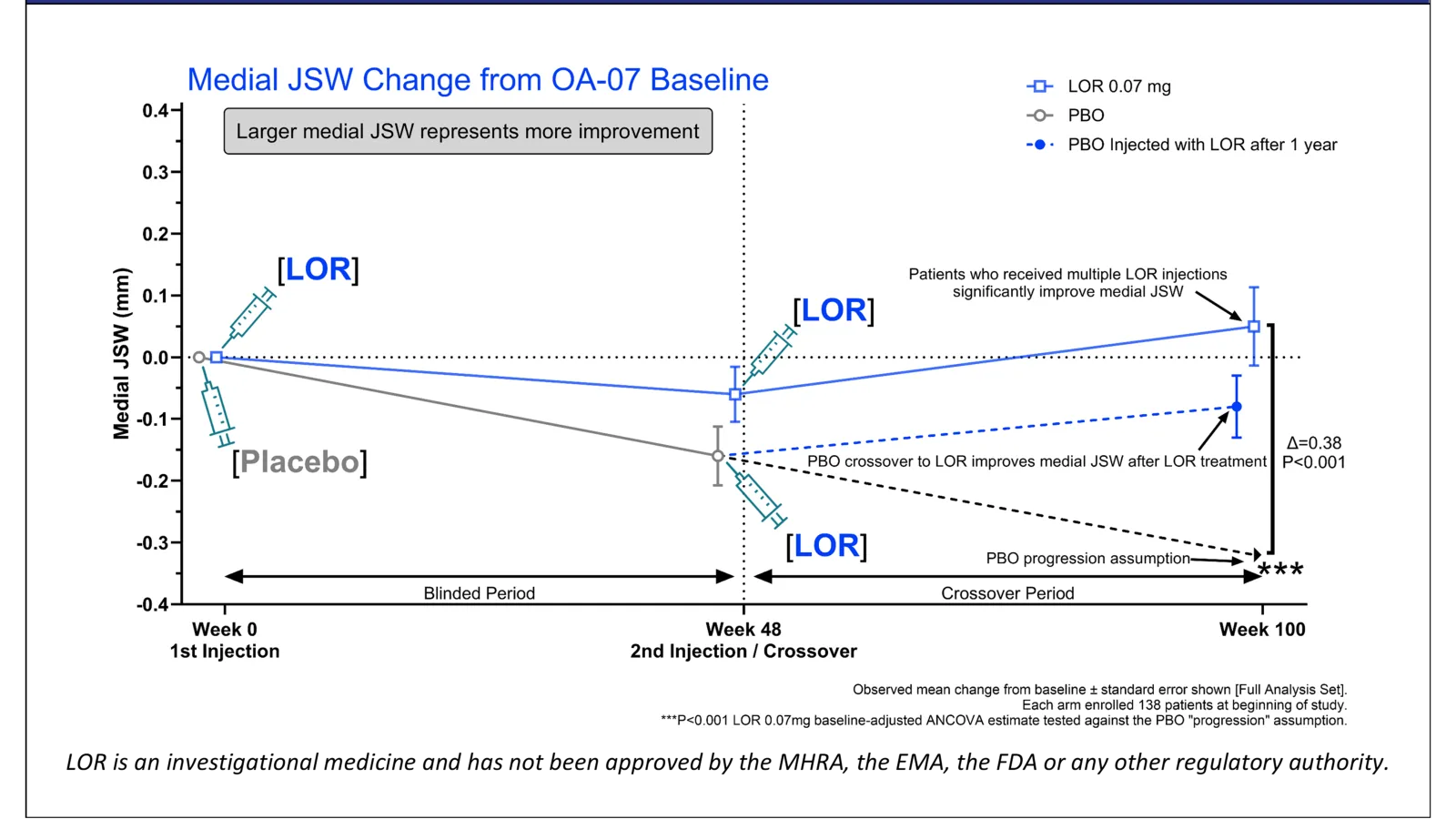
The principal evidence package rests on the Phase 3 OA-07 trial, which measured medial joint space width (JSW) by standing X-ray over two years. This endpoint is directly aligned with the EMA's own 2010 guideline on osteoarthritis medicines (CPMP/EWP/784/97 Rev.1), which accepts X-ray-measured joint space narrowing with standardised methodology as a primary structural endpoint. Biosplice says LOR-treated patients maintained and then improved medial JSW over two years, while placebo patients who crossed over to active treatment also showed JSW gains.
Beyond the structural readout, OA-07 reported statistically significant improvements in pain scores at six months and in both pain and function at 12 months versus placebo. Chief medical officer Yusuf Yazici noted that the company incorporated the EMA's stated evidentiary standard into its clinical development plan from the outset: "European regulators specified what counts as evidence of structural damage in osteoarthritis back in 2010: joint space narrowing measured by standing X-ray, with standardized methodology, is an acceptable primary endpoint. We included this standard in our clinical development program, which also demonstrated significant benefit in pain and function."
Market context and competitive landscape
Osteoarthritis affects an estimated 500 million adults globally, with around 50 million in the United States alone, and no disease-modifying therapy has yet been approved anywhere in the world. Standard-of-care remains symptomatic: analgesics, physiotherapy, corticosteroid injections, and ultimately joint replacement. The absence of any approved DMOAD (disease-modifying osteoarthritis drug) represents one of the longest-standing unmet needs in musculoskeletal medicine, and several development programmes have failed to clear the structural endpoint bar over the past two decades.
Biosplice's intra-articular, small-molecule approach differs mechanistically from earlier attempts, which have included anti-nerve growth factor antibodies, FGF-18 analogues, and various growth-factor programmes. The CHMP confirmed in February 2026 that lorecivivint qualifies for the centralised procedure as a new active substance, a designation that should streamline review across all EU member states simultaneously. The EMA's standard review timeline runs to 210 active days, though the clock can pause for company responses to questions. A regulatory decision in Europe is therefore unlikely before late 2027 at the earliest.
Biosplice has not yet filed with the FDA, and chief executive Erich Horsley used the European validation announcement to signal commercial ambitions in the US market, where no DMOAD approval has been granted. Whether a US filing follows and on what timeline will be a key watch point for investors monitoring the company's next steps.